Vendor: Akronic, P.C. Category: PLL

X-band (7.9 − 9.8GHz) High Performance Frac-N PLL

The NEXUS9X is a CMOS high performance PhaseLocked Loop (PLL) with integrated voltage controlled oscillator (VCO) and loop filter…

Overview

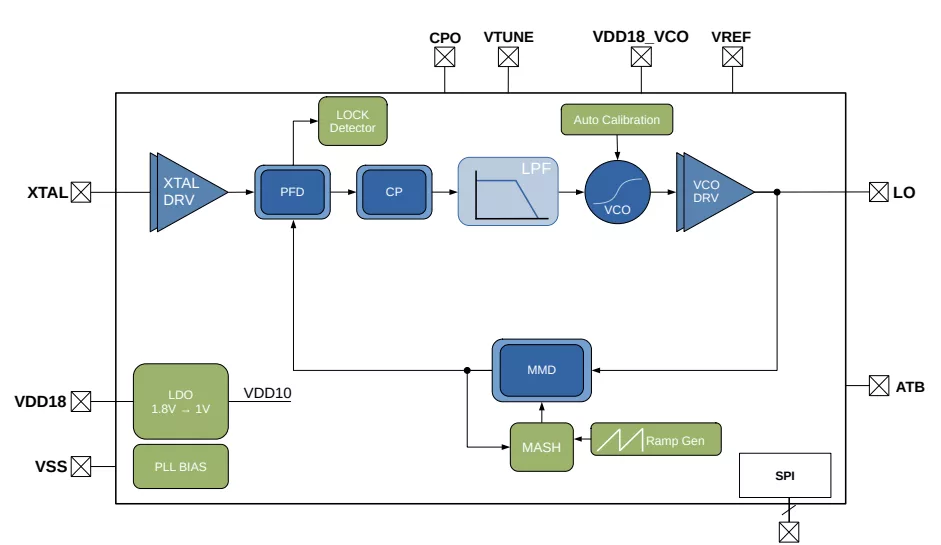
The NEXUS9X is a CMOS high performance PhaseLocked Loop (PLL) with integrated voltage controlled oscillator (VCO) and loop filter, designed to provide high flexibility in its use in order to adapt to a variety of applications. It covers typically the frequency range [7.9 − 9.8]GHz over variations in process, voltage and temperature (PVT), which can be scaled up/- down by using frequency multipliers/dividers, depending on the application. It requires a [40 − 320]MHz external reference and utilizes a fractional-N divider providing high frequency resolution and minimum phase noise (PN). Additional features, such as automatic VCO calibration, lock detection and frequency ramp generator for frequency-modulated continuous-wave (FMCW) Radar applications makes this PLL highly functional and adaptable. Also, external filter and/or VCO can be used, if required. Communication with the PLL is done through Serial Peripheral Interface (SPI).

Key features

  • Fractional-N PLL
  • Excellent phase noise (PN) performance
  • Output frequency range: 7.9 − 9.8 GHz
  • Input reference frequency range: 40 − 320 MHz
  • Wide range of CP current levels
  • Integrated loop filter
  • Automatic VCO calibration
  • Automatic VCO temperature drift compensation
  • Phase lock detection
  • Internal frequency ramp generator for FMCW RADAR
  • Supports use of external filter and/or VCO

Block Diagram

Applications

  • 5G PtP and PtMP communication systems
  • Wireless devices (WiFi, LTE, IoT)
  • Fixed wireless access
  • SATCOM
  • Radar (FMCW support)

What’s Included?

  • Evaluation board
  • Netlist
  • Layout Exchange Format, .lib files
  • GDSII
  • Footprint (LEF)
  • Testbenches (optional)
  • Documentation
  • Behavioural model (verilog/verilogA)

Specifications

Identity

Part Number
NEXUS9X
Vendor
Akronic, P.C.
Type
Silicon IP

Files

Note: some files may require an NDA depending on provider policy.

Provider

Akronic, P.C.
HQ: Greece
Specialized in RF and mmWave IC design, Akronic is a fabless semiconductor company providing cutting-edge silicon solutions and design services for wireless transceivers, RADAR sensors and antenna beamforming systems. In tight collaboration with customer internal teams, Akronic delivers highly integrated microelectronics extending from prototyping to production turnkey solutions, enabling working silicon realities. Customers span from tier-1 players to stealth-mode start-ups across the telecom, automotive, aerospace and IoT market sectors. Akronic continuously keeps abreast of the latest market and technology trends and delivers silicon breakthroughs for Active Electronic Steerable Antennas (AESA) for 5G, SATCOM and RADAR. By combining optimal system architecture and calibration methodologies, with innovative mmWave circuit and packaging design techniques, Akronic offers unique blending of performance and overall recurring cost. Akronic's extensive silicon portfolio, among others, includes the agile ALTUS28TR Ka-band transceiver, its companion NEXUS9X, X-band, supreme performance fractional-N PLL (with FMCW RADAR support), and a cutting-edge high-output power Ka-band beamformer.

Learn more about PLL IP core

Creating a Frequency Plan for a System using a PLL

How do you ensure that every part of a system receives the clock it needs—without wasting power or sacrificing performance? The answer lies in creating a well-structured frequency plan built around a PLL.

Specifying a PLL Part 3: Jitter Budgeting for Synthesis

This white paper is aimed at system architects and physical implementation leaders working on the design of SoCs. It can be confusing to understand the impact of different jitter sources and how to calculate a jitter budget when specifying a digital system. This white paper explains how jitter changes the period of a clock and how to ensure that jitter has correctly been accounted for in the calculations for timing closure.

Specifying a PLL Part 2: Jitter Basics

This article explains a some of the key terminology and parameters commonly used to describe jitter. It will also help clarify the most important parameters for a some PLL applications, allowing the designer to better understand what is required from a PLL.

Specifying a PLL Part 1: Calculating PLL Clock Spur Requirements from ADC or DAC SFDR

In high end RF systems, such as 5G radios, the requirements are so stringent that the source of this strongest unwanted tone can be the PLL. This article outlines how spurs in the input clock to the ADC or DAC may limit the SFDR. This in turn will set the requirements for the spurs for the input clock (from a PLL), in order to achieve a specific SFDR.

Achieving Groundbreaking Performance with a Digital PLL

This article compares analog, first-generation digital, and second-generation digital PLLs. It evaluates which type of PLL may be best in which situation. It further discloses a roadmap into other application areas, including general purpose / logic clocking, and regular low-jitter PLLs.

Frequently asked questions about PLL IP cores

What is X-band (7.9 − 9.8GHz) High Performance Frac-N PLL?

X-band (7.9 − 9.8GHz) High Performance Frac-N PLL is a PLL IP core from Akronic, P.C. listed on Semi IP Hub.

How should engineers evaluate this PLL?

Engineers should review the overview, key features, supported foundries and nodes, maturity, deliverables, and provider information before shortlisting this PLL IP.

Can this semiconductor IP be compared with similar products?

Yes. Buyers can compare this product with similar semiconductor IP cores or IP families based on category, provider, process options, and structured technical specifications.

×
Semiconductor IP