Vendor: Arteris Category: Network-On-Chip

FlexNoC Interconnect IP

Physically aware network-on-chip IP designed to speed development.

Overview

Physically aware network-on-chip IP designed to speed development.

FlexNoC® Interconnect IP is used by the world’s top semiconductor design teams as the backbone for on-chip communications in chips that target the fastest growing markets. It enables efficient data movement and provides flexibility in complex designs. FlexNoC benefits include:

  • Accelerate development cycles
  • Increase system performance
  • Reduce latency
  • Improve quality of results
  • Increase power efficiency

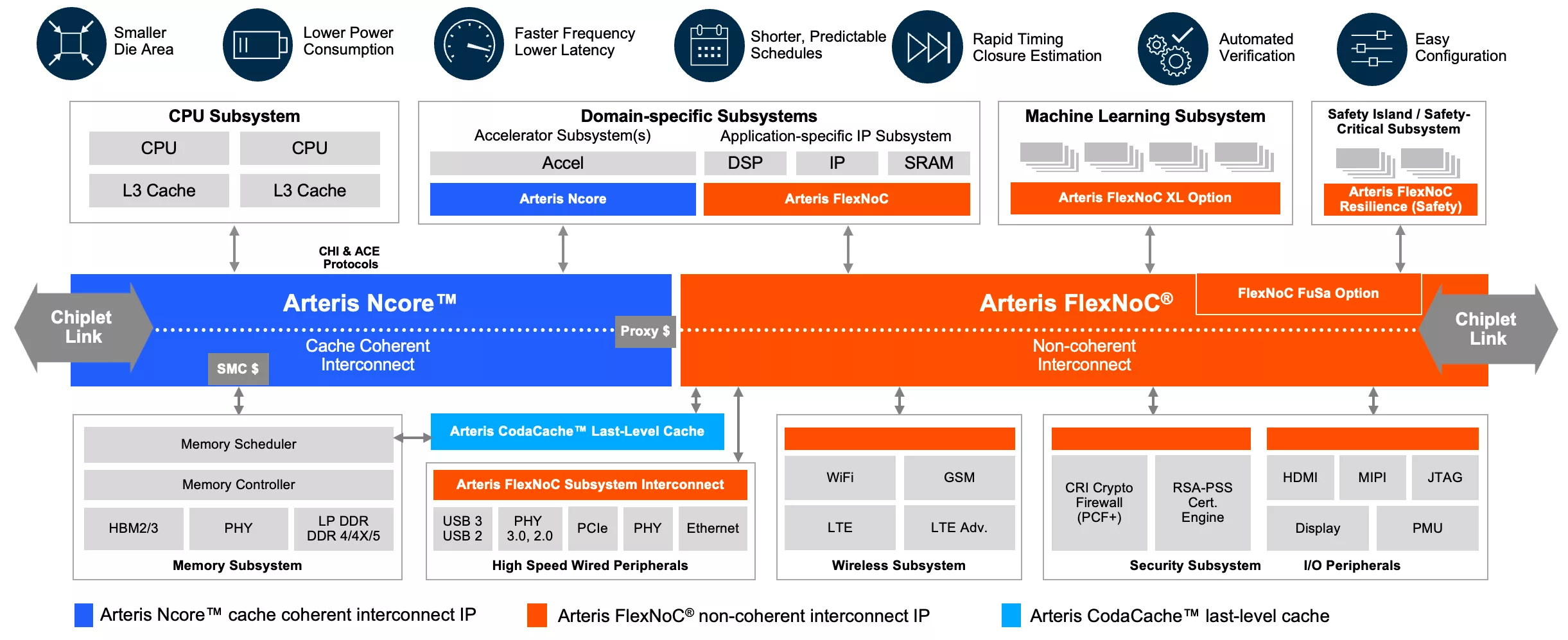
Using both FlexNoC and Ncore IP in an ASIC design also delivers unparalleled performance optimization, scalability, and system integration. This in turn supports market differentiation and helps accelerate time to market.

Key features

  • Auto-timing closure assist
  • NIU (Network Interface Unit) tiling to organize NIUs into modular, repeatable blocks, improving scalability, efficiency, and reliability
  • Topology visualized directly on floorplan
  • Multi-clock/power/voltage domains and power management with unit-level clock gating
  • Multi-protocol support including AMBA 5 with QoS bandwidth regulator and limiter enumerations
  • General optimizations for lower area e.g. up to 30% for some NoC elements depending on configuration
  • Native and user-defined firewall security
  • Import and export to Magillem tools
  • AMBA 5 support of DVM 8.1 (Distributed Virtual Memory)
  • On-chip performance monitoring and debug
  • Debug and trace with ATB 128b and timestamps

Block Diagram

Benefits

Flexible topologies

FlexNoC is generated from simple elementary components, combined using a powerful set of underlying algorithms and an intuitive GUI, making it possible to build any topology.

Small to large SoCs

FlexNoC easily supports long cross-chip paths by leveraging source-synchronous communications and virtual channels.

Huge bandwidth

FlexNoC drives performant on-chip data flow and access to off-chip memory by enabling multichannel HBMx memory and high-bandwidth data paths.

Applications

  • Automotive,
  • Mobility,
  • Wireless,
  • Consumer Electronics,
  • IoT,
  • Server,
  • Networking and Industrial SoCs

What’s Included?

  • FlexNoC 5 Physically Aware Interconnect IP
  • Configuration tools
  • Automated testbench generator
  • Documentation, training, and support.
  • Safety Manual -- when licensed with the Functional Safety (FuSa) Option

Specifications

Identity

Part Number
FlexNoC Interconnect IP
Vendor
Arteris
Type
Silicon IP

Videos

Arteris FlexNoC 5 Physically Aware Network-on-Chip IP
Arteris unveils next-generation FlexNoC 5 physically aware network-on-chip IP. Get up to 5X faster physical convergence vs manual physical iterations and achieve PPA goals within schedule and budget constraints.

Files

Note: some files may require an NDA depending on provider policy.

Provider

Arteris
HQ: United States
Arteris is a leading provider of semiconductor technology that accelerates the creation of high-performance, power-efficient silicon with built-in safety, reliability, and security. Innovative Arteris products are designed to optimize data movement and help ease complexity in the modern AI era with network-on-chip (NoC) interconnect intellectual property (IP), system-on-chip (SoC) software for integration automation and hardware security assurance. All are used by the world’s top technology companies to improve overall performance and engineering productivity, reduce risk, lower costs, and bring cutting-edge designs to market faster.

Learn more about Network-On-Chip IP core

Secure Multi-Path Routing with All-or-Nothing Transform for Network-on-Chip Architectures

Ensuring Network-on-Chip (NoC) security is crucial to design trustworthy NoC-based System-on-Chip (SoC) architectures. While there are various threats that exploit on-chip communication vulnerabilities, eavesdropping attacks via malicious nodes are among the most common and stealthy. Although encryption can secure packets for confidentiality, it may introduce unacceptable overhead for resource-constrained SoCs.

Why verification matters in network-on-chip (NoC) design

In this article, we will dive deeper into a comprehensive methodology for formally verifying an NoC, showcasing the approaches and techniques that ensure our NoC designs are robust, efficient, and ready to meet the challenges of modern computing environments.

SoC design: When a network-on-chip meets cache coherency

Many people have heard the term cache coherency without fully understanding the considerations in the context of system-on-chip (SoC) devices, especially those using a network-on-chip (NoC). To understand the issues at hand, it’s first necessary to understand the role of cache in the memory hierarchy.

Accelerating RISC-V development with network-on-chip IP

In the world of system-on-chip (SoC) devices, architects encounter many options when configuring the processor subsystem. Choices range from single processor cores to clusters to multiple core clusters that are predominantly heterogeneous but occasionally homogeneous.

Network-on-chip (NoC) interconnect topologies explained

Today’s complex system-on-chip (SoC) designs can contain between tens to hundreds of IP blocks. Each IP block may have its own data width and clock frequency and employ one of the standard SoC interface protocols: OCP, APB, AHB, AXI, STBus, and DTL. Connecting all these IPs is a significant challenge.

Frequently asked questions about NoC IP cores

What is FlexNoC Interconnect IP?

FlexNoC Interconnect IP is a Network-On-Chip IP core from Arteris listed on Semi IP Hub.

How should engineers evaluate this Network-On-Chip?

Engineers should review the overview, key features, supported foundries and nodes, maturity, deliverables, and provider information before shortlisting this Network-On-Chip IP.

Can this semiconductor IP be compared with similar products?

Yes. Buyers can compare this product with similar semiconductor IP cores or IP families based on category, provider, process options, and structured technical specifications.

×
Semiconductor IP