Overview
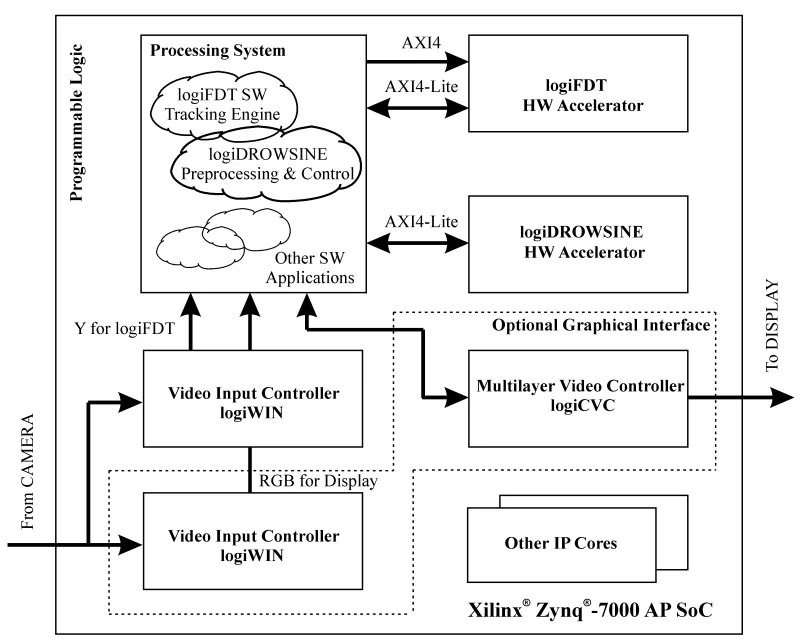
The logiDROWSINE is a computer vision IP core that detects driver drowsiness and distraction based on facial movements monitored through a camera placed in a vehicle cabin. The IP core monitors movements of driver's eyes, gaze, eyebrows, lips and head, and continuously tracks nine facial behavioral features that indicate the drowsiness: PERCLOS, microsleep, yawn and others. Based on the behavioral features tracked during the driving, the implemented classifiers recognize seven levels of drowsiness that can be used as driver alerts or inputs in other ADAS applications.
The logiDROWSINE is carefully partitioned between hardware and software to assure high performance and optimal utilization of the Xilinx Zynq-7000 AP SoC. The complete driver drowsiness SoC design, which consists of the logiDROWSINE, logiFDT and other IP cores, fits into the smallest Xilinx Zynq SoC and use only a single CPU core. It is prepackaged for the Xilinx Vivado Design Suite and IP deliverables include the software driver, documentation and technical support.
Learn more about Vision Subsystem IP core
Priya Balasubramanian, Cadence
With artificial intelligence (AI) being used for a growing number of use cases in an expanding set of industries, semiconductor providers face immense pressure to keep pace with rising workload complexity and specialization. From real-time language processing to vision-based applications and instruction-driven models, AI workloads require silicon solutions that are not only powerful but also efficient, optimized for specific use cases, and able to scale with the extension of AI infrastructure.
Physical AI will enable the next generation of autonomous robots to sense the world around them, think to create a plan based on their role and situational understanding, and act to implement that plan.
TIP SMitra, Cadence
The world of artificial intelligence is moving beyond the cloud and into our everyday devices from smart sensors to robotics and AR/VR headsets.