Vendor: Commsonic Ltd Category: Modulation Demodulation

ATSC 8-VSB modulator

The CMS0033 ATSC 8-VSB Modulator with integrated Channel Coder has been designed specifically to implement the 8-VSB requirements…

Overview

The CMS0033 ATSC 8-VSB Modulator with integrated Channel Coder has been designed specifically to implement the 8-VSB requirements of the ATSC Digital Television Standard (A/53).

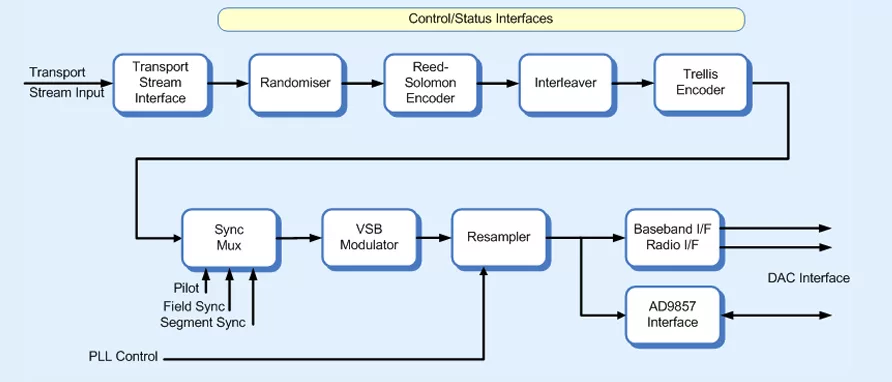
The core provides all the necessary processing steps to modulate a single transport stream into a complex I/Q signal for input to a pair of DACs, or a DDS up-conversion DAC such as the AD9857(or AD9957). Optionally, the output can be selected as an IF to supply a signal DAC.

The design has been optimised to provide excellent performance in FPGA devices. A description of the processing steps follows:

Randomiser. This block performs energy dispersal by scrambling the incoming transport stream packets with a pseudo-random sequence.

Reed-Solomon Encoder. This block constructs 207-byte Reed Solomon codewords by applying a T=10 (207,187) code to the scrambled transport stream packets.

Interleaver. This block uses convolutional byte interleaving to disperse the Reed Solomon codewords over a period of approximately 4ms.

Convolutional Encoder. This block applies a rate 2/3 convolutional code to the interleaved data by means of a 4-state trellis encoder. The 3-bit encoder output symbols are mapped to 8-level 8 VSB constellation points.

Sync Multiplexer. This block inserts Field Sync and Segment Sync sequences into the transmitted symbol stream and adds a low-level Pilot signal. These signals are used for physical-layer synchronisation at the receiver.

VSB Modulation. This block performs vestigial sideband modulation of a locally-generated baseband carrier, driven by the composite output from the Sync Multiplexer.

Rate Conversion. This block re-samples the complex samples output from the VSB Modulation block at symbol-rate into complex samples at a sub multiple of the DAC/core clock frequency.

A frequency control input is provided to allow the modulation symbol rate to be locked to the data rate on the transport stream interface. This would typically be driven by a PLL, for example when the SMPTE 310M interface option is selected.

Baseband-to-IF. This block provides the option to mix the signal up to a higher IF as defined by a software register. The block may be removed using synthesis options if it is not required.

Radio Interface. This block performs some final, register-selectable processing functions to optimise the output for the radio in the target application. For example, the data can be formatted to work with either twos-complement or offset-binary DAC devices. In addition the data is formatted to suit the external device that could take separate I/Q, multiplexed I/Q or a single IF output.

Additional modes are provided to support the Analog Devices AD9857 device that provide up conversion, SINC filtering and DAC functions in a single package. The AD9857 device requires that the I/Q data be multiplexed onto a single data bus. The ad9857_pdclk input is provided to enable this feature and should be sourced from the AD9857 PDCLK output

Control/Status Interface. The Control/Status interface is provided by a synchronous, 32-bit register bank. Full details of the registers within the modulator core are contained within the full data sheet.

Key features

  • Compliant with ATSC A/53 8-VSB
  • Variable sample-rate interpolation provides ultra-flexible clocking strategy
  • Integrated Reed Solomon/Convolutional channel coder
  • Automatic insertion of Segment Sync, Field Sync and Pilot signals
  • Extension core available for SPI/ASI interface with integrated PCR TS re-stamping.
  • Extension core available for SMPTE 310M interface with DPLL timing synchronisation
  • Flexible DAC interface compatible with baseband I/Q and IF DAC subsystems
  • Optional interface to Analog Devices AD9857 DDS DAC
  • Modes that are not required may be removed with synthesis options to generate a compact, efficient design.
  • Designed for very efficient FPGA implementation without compromise to the targeting of gate array or standard cell structures.
  • Supplied as a protected bitstream or netlist (“megacore” also available for Altera targets).

Block Diagram

Files

Note: some files may require an NDA depending on provider policy.

Specifications

Identity

Part Number
CMS0033
Vendor
Commsonic Ltd
Type
Silicon IP

Provider

Commsonic Ltd
HQ: UK
Commsonic is a design services company specialising in the development of ASIC, FPGA, DSP and board-level sub-systems for applications in wireless and wireline communications.

Our expertise is primarily in the gate- and power-efficient implementation of physical-layer (PHY) functions such as: modulation, demodulation, equalisation and channel coding but our experience encompasses all of the major elements of a modern baseband 'core' including the medium access control (MAC), voiceband DSP, mixed-signal interfaces, and embedded Cpu and software.

Our services are provided on a turnkey basis or as part of a support package attached to our licenced IP or tool products.

Commsonic's customers are typically semiconductor vendors and manufacturers of communications equipment that require leading-edge, Standards-based or proprietary PHY solutions but lack the internal resources or skills necessary to deliver projects against aggressive deadlines.

Learn more about Modulation Demodulation IP core

Three Major Inflection Points for Sourcing Bluetooth Intellectual Property

Synopsys is now shipping support for Bluetooth® 5.4, the latest specification from the Bluetooth SIG (Special Interest Group). The enhancements in Bluetooth 5.4 will open additional markets and use cases. This is one of the many inflection points in the Bluetooth Low Energy market that will be discussed in this paper.

Part 2: Opening the 5G Radio Interface

Carriers are now deploying 5G across the globe driven by the need to keep up with relentless mobile data growth. 5G New Radio (NR) operates at higher frequencies to increase bandwidth, but at the expense of range. There will therefore be a need for a much larger number of 5G RUs to provide the same coverage. The availability of cost-effective, reliable and open 5G radio units is therefore critical.

An Integrated, Tunable RF Filter: an Enabler for Reconfigurable Front-Ends

This paper presents the design and performance of a key RF circuit necessary for the realization of a reconfigurable, integrated RF front-end: a tunable frequency, selectable bandwidth, on-chip, “SAW replacement” filter. The on-die tunable filter presented here has a tunable center frequency up to 1 GHz, a selectable bandwidth up to 40 MHz, and an adjacent channel rejection down to 60 dB.

Design considerations for integrated CMOS receivers

To meet the demands for the multi-band, multi-mode wireless standards in the current market, a highly integrated wireless receiver (RX) is desired. CMOS technology has become the technology of choice for the integrated receiver design.

Silicon IP for Programmable Baseband Processing

An efficient IP reuse strategy relies on IP blocks with wide applicability. That makes generic blocks, such as programmable processors preferable. However, in many applications such as handheld wireless terminals, additional silicon area and power consumption compared to fixed function solutions can not be accepted.

Frequently asked questions about Modulation and Demodulation IP cores

What is ATSC 8-VSB modulator?

ATSC 8-VSB modulator is a Modulation Demodulation IP core from Commsonic Ltd listed on Semi IP Hub.

How should engineers evaluate this Modulation Demodulation?

Engineers should review the overview, key features, supported foundries and nodes, maturity, deliverables, and provider information before shortlisting this Modulation Demodulation IP.

Can this semiconductor IP be compared with similar products?

Yes. Buyers can compare this product with similar semiconductor IP cores or IP families based on category, provider, process options, and structured technical specifications.

×
Semiconductor IP