UCIe D2D Adapter Explained: Architecture, Flit Mapping, Reliability, and Protocol Multiplexing
Understand the role of the UCIe D2D Adapter in enabling reliable, scalable, multi-protocol die-to-die communication for chiplet architectures.
The AHB-Lite to AHB-Lite Asynchronous Bridge translates an AHB-Lite bus transaction (read or write) on one clock domain to an AHB…
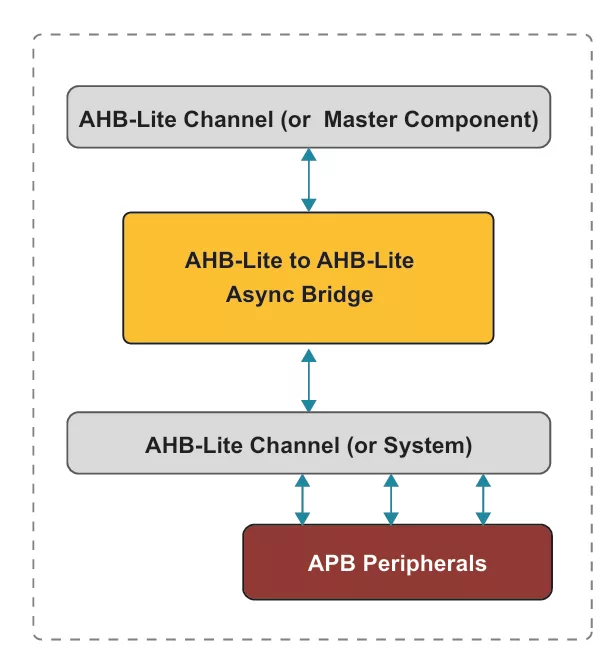
The AHB-Lite to AHB-Lite Asynchronous Bridge translates an AHB-Lite bus transaction (read or write) on one clock domain to an AHB-Lite bus transaction on a second (asynchronous) clock domain. This allows two completely independent AHB-Lite systems to communicate and share data. The bridge is implemented as two state machines - one on the initial or “A” domain and another on the secondary or “B” domain, and several synchronizers. The AHB-Lite to AHB-Lite Asynchronous Bridge acts as an AHB-Lite Slave on the “A” domain, and an AHB-Lite Master on the “B” domain.
Note: some files may require an NDA depending on provider policy.

AHB-Lite to AHB-Lite Asynchronous Bridge is a Protocol Bridge IP core from Silvaco, Inc. listed on Semi IP Hub.
Engineers should review the overview, key features, supported foundries and nodes, maturity, deliverables, and provider information before shortlisting this Protocol Bridge IP.
Yes. Buyers can compare this product with similar semiconductor IP cores or IP families based on category, provider, process options, and structured technical specifications.