Learn more about Oscillator IP core
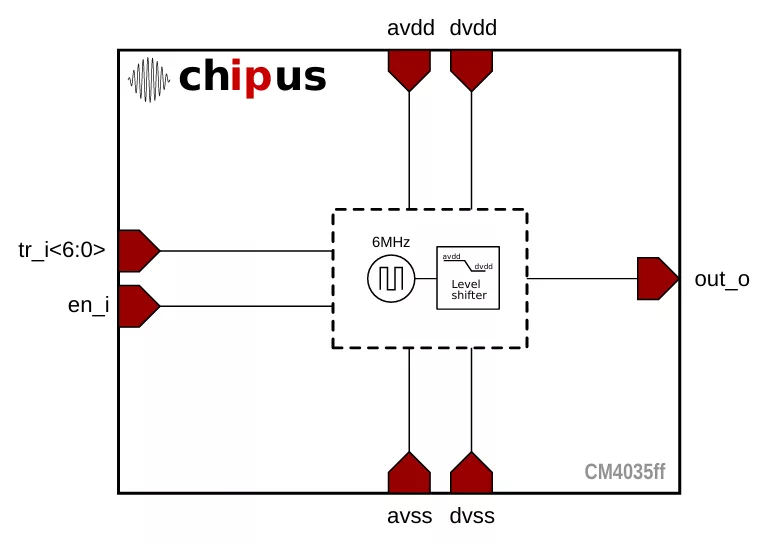
In this paper, we present a flexible ring oscillator IP designed for a 40nm CMOS technology, whose oscillation frequency can be chosen from 200kHz to 20MHz. It was developed using a new design approach, in which analog IPs are designed from scratch to be flexible, employing modular blocks that can be easily customized. The IP is silicon proven. It works with a supply voltage of 1.2V and features 5% frequency accuracy, occupying an area of 0.0022mm2.
This article outlines Key ASIC R&D team's upcoming PLL suitable for high-speed SerDes having ultra low jitter with LC- tank VCO, and supporting up to 16 GHz output clock to sample the data.
This article outlines our R&D team's upcoming PLL suitable for high-speed SerDes having ultra low jitter with LC- tank VCO, and supporting up to 16 GHz output clock to sample the data.
How do you ensure that every part of a system receives the clock it needs—without wasting power or sacrificing performance? The answer lies in creating a well-structured frequency plan built around a PLL.
Agile Analog’s tamper detection IP is a comprehensive set of sensors and monitors designed to detect a wide variety of physical attacks and side-channel attacks (SCAs). T
Unfortunately, precise thermal monitoring reached an inflection point at 2nm, with traditional solutions proving less practical below 3nm. To tackle the issue, this article delves into a novel approach, accurate to ±1.0°C, that overcomes this critical challenge.