Vendor: Kamaten Technology Incorporated Category: Test / Debug

32Gbps, 31 order, Pseudo Random Bit Sequence Generator / Checker

This unit generates and checks Pseudo Random Bit Sequence (PRBS) of 31 order, up to 32Gbps.

Overview

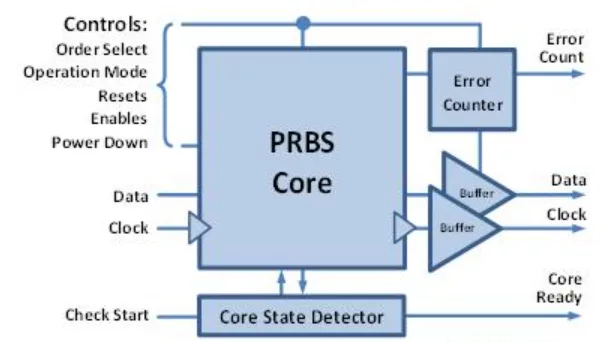
This unit generates and checks Pseudo Random Bit Sequence (PRBS) of 31 order, up to 32Gbps. It can work in Generator only, Checker/Counter only or both simultaneously. In error checking mode unit may output PRBS signal, always error free. Embedded 10-bit error counter is accurate: no double counts or omissions regardless of error sequence or frequency of occurrences. Error count may start, stop or be reset at any time with no need to stop or reset the entire unit. Error count range is expandable (see Application Note). Indicator signal facilitates switching between Generator and Checker mode. Footprint is small, no inductors are used minimizing area and EM interference. Simple control interface, with low frequency asynchronous signals only. Unit is designed in TSMC 28HPC/HPC+ process. Design may be ported to more advanced process nodes.

Key features

  • PRBS order: 31 based on formula: X1=X28^X31
  • Full bit rate at input and output up to 32Gbps
  • Generator, Checker and Counter functions
  • Accurate error count: no omissions or double counts
  • Full rate CMOS differential input data, centered with half-rate CMOS differential clock
  • Full rate CMOS differential output data, aligned with half-rate CMOS differential clock
  • Asynchronous low frequency CMOS control interface
  • Supply voltage: 0.9V
  • Typical power consumption: 70mA at 32Gbps in simultaneous Generator and Checker mode; scales with bit rate
  • Power down mode
  • Error counter ready indicator signal
  • Operational temperature range: -40C to +110C
  • Footprint: 65 x 70 um
  • Process: TSMC 28nm HPC/HPC+, portable to more advanced processes

Block Diagram

Applications

  • Unit is intended for testing of communication channels and clock/data recovery systems. Helps to verify functionality and evaluate channel and system quality and efficiency by measuring bit error rates. Unit fits well with Design for Test (DFT) approach and makes an irreplaceable element of advanced Built-in Self Test (BIST) systems.

Files

Note: some files may require an NDA depending on provider policy.

Silicon Options

Foundry Node Process Maturity
TSMC 28nm 28nm 280 nm

Specifications

Identity

Part Number
PRBS31HS-T28HPC
Vendor
Kamaten Technology Incorporated
Type
Silicon IP

Provider

Kamaten Technology Incorporated
HQ: Canada
Primarily analog and mixed signal IP development for telecommunication, automotive, consumer. Secondary activity: design services provider, full custom analog and mixed signal.

Learn more about Test / Debug IP core

Metric Driven Validation, Verification and Test of Embedded Software

Today’s complexity of embedded systems is steadily increasing. The growing number of components in a system and the increased communication and synchronization of all components requires reliable verification, validation and testing of each component as well as the system as a whole. Considering today’s cost sensitivity it is important to find errors as early as possible and to increase the degree of test automation to avoid quality losses because of the increased cost pressure.

eUSB2V2: Trends and Innovations Shaping the Future of Embedded Connectivity

In an era defined by rapid technological advancement, embedded interfaces must evolve to meet the demands of smaller form factors, lower power budgets, and diversified use cases. Among these interfaces, eUSB2V2 (Embedded USB 2.0 Version 2) has emerged not just as a legacy-support PHY, but as a strategic enabler of robust, low-power connectivity across next-generation systems-on-chip (SoCs).

PCIe 5.0: The universal high-speed interconnect for High Bandwidth and Low Latency Applications Design Challenges & Solutions

Innosilicon, a leading IP provider, offers a complete PCIe 5.0 solution stack that includes both PHY and controller IPs. Although both layers are crucial to achieving a fully compliant and high-performance PCIe interface, this paper deep dives into the technical challenges of PHY design, highlighting insights drawn from real-world design margins, receiver robustness, and advanced jitter analysis in the context of Gen5 systems.

Arasan’s xSPI/eMMC5.1 PHY: Unified Dual-Mode Physical Layer IP

As SoCs evolve to support a growing range of memory interfaces, designers are faced with the challenge of balancing integration complexity, pin efficiency, and performance scalability. Traditionally, implementing both xSPI (JESD251) for boot and eMMC 5.1 for high-speed storage required separate PHYs, leading to increased silicon area, power consumption, and I/O overhead.

Frequently asked questions about SerDes Test / Debug IP cores

What is 32Gbps, 31 order, Pseudo Random Bit Sequence Generator / Checker?

32Gbps, 31 order, Pseudo Random Bit Sequence Generator / Checker is a Test / Debug IP core from Kamaten Technology Incorporated listed on Semi IP Hub. It is listed with support for tsmc.

How should engineers evaluate this Test / Debug?

Engineers should review the overview, key features, supported foundries and nodes, maturity, deliverables, and provider information before shortlisting this Test / Debug IP.

Can this semiconductor IP be compared with similar products?

Yes. Buyers can compare this product with similar semiconductor IP cores or IP families based on category, provider, process options, and structured technical specifications.

×
Semiconductor IP