3 to 5 GHz power amplifier
130iHP_PA_02 is E class power amplifier (PA).
Overview
130iHP_PA_02 is E class power amplifier (PA). Voltage regulator is used due to transistor low breakdown voltage and PA inductive load. Such solution also provides wide range output power adjustment. Third type band-pass filter is used to provide wide bandwidth and set output impedance to 50Ohm.
The block is fabricated on iHP SiGe BiCMOS 0.13 um technology.
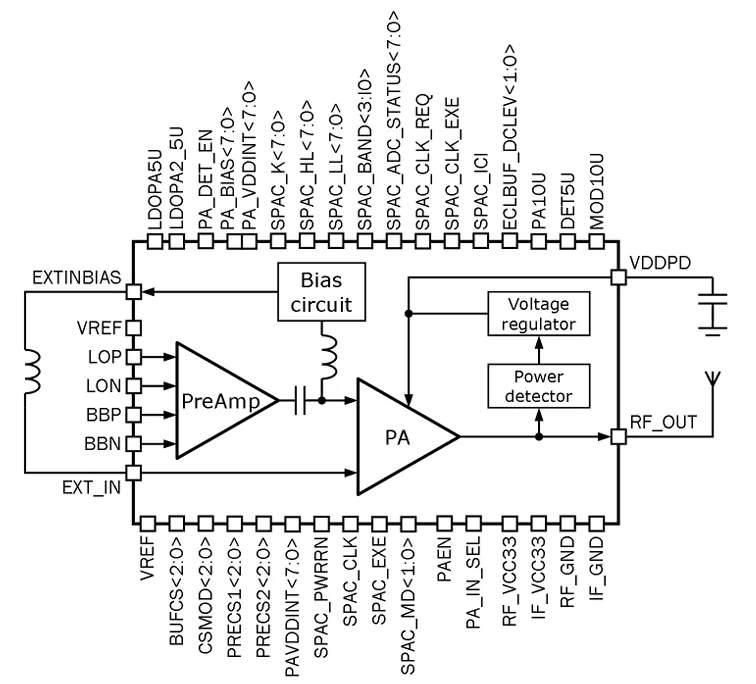
Key features
- iHP SiGe BiCMOS 0.13 um
- E class PA
- Frequency range 3…5 GHz
- Built-in voltage regulator
- Gain adjustment
- Portable to other technologies (upon request)
Block Diagram
Applications
- Portable transmitters
- Portable transceivers
- Mobile communication devices
What’s Included?
- Schematic or NetList
- Abstract model (.lef and .lib files)
- Layout view (optional)
- Behavioral model (Verilog)
- Extracted view (optional)
- GDSII
- DRC, LVS, antenna report
- Test bench with saved configurations (optional)
- Documentation
Specifications
Identity
Files
Note: some files may require an NDA depending on provider policy.

Provider
Learn more about Amplifier IP core
Powering the Future of RF: Falcomm and GlobalFoundries at IMS 2025
Real-Time ESD Monitoring and Control in Semiconductor Manufacturing Environments With Silicon Chip of ESD Event Detection
Novel Trade-offs in 5 nm FinFET SRAM Arrays at Extremely Low Temperatures
Linearity Analysis of Source-Degenerated Differential Pairs for Wireline Applications
How to Elevate RRAM and MRAM Design Experience to the Next Level
Frequently asked questions about Amplifier IP cores
What is 3 to 5 GHz power amplifier?
3 to 5 GHz power amplifier is a Amplifier IP core from NTLab listed on Semi IP Hub.
How should engineers evaluate this Amplifier?
Engineers should review the overview, key features, supported foundries and nodes, maturity, deliverables, and provider information before shortlisting this Amplifier IP.
Can this semiconductor IP be compared with similar products?
Yes. Buyers can compare this product with similar semiconductor IP cores or IP families based on category, provider, process options, and structured technical specifications.