Vendor:
Secure-IC
Category:
Random Number Generator
True Random Number Generator (TRNG)
1.5Tb MACsec ENGINE True Random Number Generators (TRNGs) are used to generate statistically independent streams of bits for vari…
Overview
1.5Tb MACsec ENGINE True Random Number Generators (TRNGs) are used to generate statistically independent streams of bits for various applications such as One Time Pad cryptography, key generation, seeds for PRNGs, masks to protect an implementation against side-channel analysis.
Random number generation is critical for any secure device. Random numbers are required for many protocols, such as key generation, key exchange, digital signature, encryption and more. Typical secure protocols like IPsec, MACsec, TLS/SSL or wireless use them during authentication/ key exchange and data streaming phases.
SCZ_IP_TRNG_DRBG is compliant with:
- AIS -31 PTG.1, PTG.2, PTG.3
- NIST FIPS 140-3
- NIST SP 800-90B
- NIST SP 800-90C
- GM/T 0078
- ISO/IEC 18031:2011
TRNG IP has passed NIST SP 800-22, OSCCA GM/T 005:2015, and AIS-31 statistical tests.
CTR-DRBG part of the TRNG IP is CAVP validated.
Ideal for
This TRNG can be used to generate extratemporaneously in secure protocols:
- Nonce involved in digital signatures
- Keys to be involved in key exchanges (Diffie-Hellman, Key Encapsulation Mechanisms, etc.)
- Unpredictable seeds to implement random masking or shuffling schemes.
Other use-cases concern some algorithms initializations or timer applications:
- Optimization problems based on simulated annealing or genetic algorithms
- Neural networks training
- Numerical recipes, such as Monte-Carlo simulation or multidimensional integration
- Random timers in communications protocols
Key features
- Fully digital, can be used seamlessly in any foundry and any technology node (no need to access Process Design Kit)
- Robust against process, temperature and voltage variations
- Formal security validation (stochastic model)
- Entropy source is fully digital and designed with standard cells library
- Can be implemented out of the box from RTL + SDC file
- Fully hardware cryptographic CTR-DRBG for high bit-rate random data
- Fully adaptable according to customer’s needs in terms of throughput, frequency and area
- Safety document package for ISO26262 available as an option
- Availability of different rationales as required by OSCCA schemes
- Multiple times silicon proven, down to 5nm
- Easy to integrate into the system
- AMBA (AXI) interface
Block Diagram
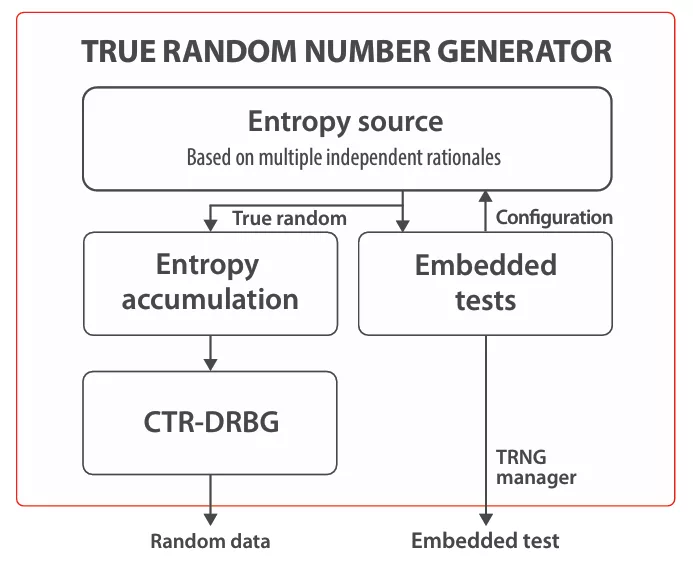
SCZ_IP_TRNG_DRBG block diagram
Applications
- Defense
- IPSec (VPN)
- TLS/SSL
- Automotive
- IoT
- Wearable devices
- Embedded security
What’s Included?
- Technical specifications
- TRNG IP
- RTL code of the entropy source
- Remote support for integration
- User guide
- RTL of the AMBA wrapper
- SDC file
- Test report documentation
- Self-checking RTL Testbench based on reference scenario for simulation. (Simulation scripts are adapted to Questasim, any change of Simulator shall be taken care of by the Licensee)
Specifications
Identity
Part Number
SCZ_IP_TRNG_DRBG
Vendor
Secure-IC
Type
Silicon IP
Security
RNG Type
TRNG
Files
Note: some files may require an NDA depending on provider policy.
Provider

Secure-IC
HQ:
France
With presence and customers across 5 continents, Secure-IC is the rising leader and the only global provider of end-to-end cybersecurity solutions for embedded systems and connected objects. Driven by a unique approach called PESC (Protect, Evaluate, Service & Certify), Secure-IC positions itself as a partner to support its clients throughout and beyond the IC design process. Relying on innovation and research activities, Secure-IC provides Silicon-proven and cutting-edge protection technologies, integrated Secure Elements and security evaluation platforms to reach compliance with the highest level of certification for different markets (such as automotive, AIoT, defense, payments & transactions, memory & storage, server & cloud).
Discover in preview of Secure-IC new Securyzr Server to manage the security of heterogeneous fleets of IoT devices throughout their lifecycle
Learn more about Random Number Generator IP core
How random is random?
Brian Bailey
The Silent Guardian of AI Compute - PUFrt Unifies Hardware Security and Memory Repair to Build the Trust Foundation for AI Factories
At the scale of the Vera Rubin platform, yield, calibration, and security failures compound across tens of thousands of devices. A single unified hardware anchor at the silicon level is not optional, it is architectural necessity. A physical unclonable function-based hardware root-of-trust, PUFrt, jointly developed by eMemory and PUFsecurity, was designed precisely for this role: a fully integrated implementation of the Caliptra 2.0 open standard that simultaneously manages cross-die memory repair and hardware root of trust across the full platform.
A Comprehensive Post-Quantum Cryptography (PQC) Solution based on Physical Unclonable Function (PUF)
This article provides an in-depth analysis of the specific PPA challenges introduced by PQC and elucidates how PUF-PQC leverages its unique dualtrack strategy to deliver a robust and flexible Hardware Root of Trust (HRoT) across diverse application scenarios. Furthermore, it demonstrates the integration of Physical Unclonable Function (PUF) with a NIST SP 800-90B compliant True Random Number Generator (TRNG) to serve as critical components of PUFrt (Root of Trust), ensuring the security of post-quantum key generation starting from the entropy source.
X100 - Securing the System - RISC-V AI at the Edge
For years, SiFive has been delivering a range of security capabilities that are optimized for deployment throughout the system, tightly coupled to products from its broad portfolio of processors. Building on the prior blogs that centered on performance and effective coupling of accelerators, I wanted to focus this blog on security and its role in the growing popularity of the SiFive Intelligence X100 product family.
Tailoring Root Of Trust Security Capabilities To Specific Customer Needs
A Root of Trust is the foundation on which all secure operations of a computing system depend. It contains the keys used for cryptographic functions and enables a system-wide secure boot process. It is inherently trusted and therefore must be secure by design.
Frequently asked questions about Random Number Generator IP cores
What is True Random Number Generator (TRNG)?
True Random Number Generator (TRNG) is a Random Number Generator IP core from Secure-IC listed on Semi IP Hub.
How should engineers evaluate this Random Number Generator?
Engineers should review the overview, key features, supported foundries and nodes, maturity, deliverables, and provider information before shortlisting this Random Number Generator IP.
Can this semiconductor IP be compared with similar products?
Yes. Buyers can compare this product with similar semiconductor IP cores or IP families based on category, provider, process options, and structured technical specifications.