
Vendor: NTLab Category: Power On Reset (POR)

Power on Reset

065TSMC_PoR_02 is a Power-on-Reset (PoR) circuit provides a reset signal to the chip when supply voltage reach required level.

TSMC 65nm GP Silicon Proven View all specifications

Overview

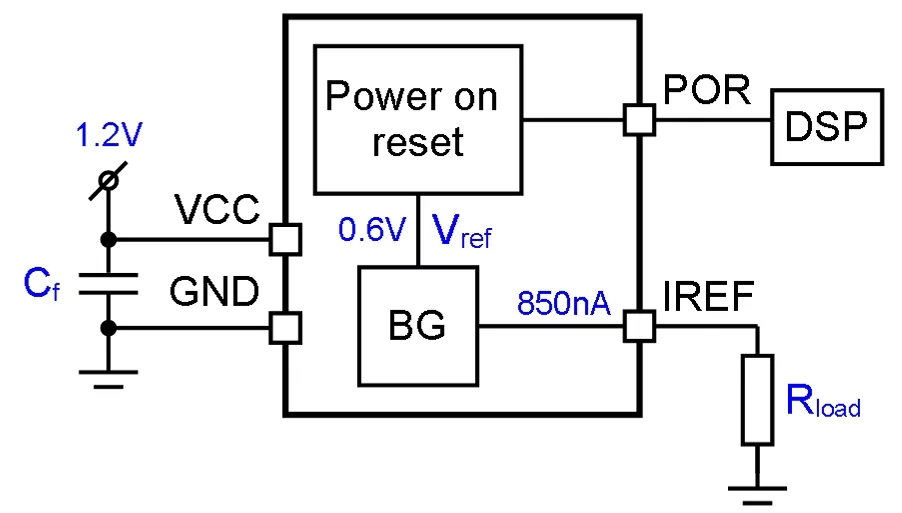
065TSMC_PoR_02 is a Power-on-Reset (PoR) circuit provides a reset signal to the chip when supply voltage reach required level. The block generates reset signal depending of the level supply voltage with hysteresis. It includes bandgap with reference current and Power on Reset block.

Key features

  • TSMC CMOS 65 nm
  • Input voltage range: from 0.9 V to 1.3 V
  • Embedded power on reset module
  • Low quiescent current
  • Portable to other technologies (upon request)

Block Diagram

Applications

  • Core voltage low battery indication
  • Supply voltage sensitive circuits
  • Battery-Powered equipment
  • Power solutions

What’s Included?

  • Schematic or NetList
  • Abstract model (.lef and .lib files)
  • Layout view (optional)
  • Behavioral model (Verilog)
  • Extracted view (optional)
  • GDSII
  • DRC, LVS, antenna report
  • Test bench with saved configurations (optional)
  • Documentation

Files

Note: some files may require an NDA depending on provider policy.

Silicon Options

Foundry Node Process Maturity
TSMC 65nm GP Silicon Proven

Specifications

Identity

Part Number
065TSMC_PoR_02
Vendor
NTLab
Type
Silicon IP

Provider

NTLab
HQ: Lithuania
NTLab is a vertically integrated microelectronics design center. It has 70+ experienced and qualified engineers. NTLab specializes in the designing of mixed-signal and RF ICs and Systems-on-Chip. It has a wide range of own silicon-verified IP blocks: processor cores, interfaces, analog and high-frequency PHYs, etc., thus allowing customized design to be fast and predictable. In-company unique combination of competences in digital, analog and RF circuits and embedded software enables NTLab to participate in the projects that require deep research and utilize most sophisticated and advanced techniques: multi-system GPS/GLONASS/Galileo/BeiDou/NavIC(IRNSS)/QZSS/SBAS navigation, RF ID, wireless communications, etc. All designed ICs are provided with test and development tools, as well as with reference software. NTLab offers a wide range of silicon proven analog/mixed-signal IPs in 0.35µm, 0.25 µm, 0.18 µm, 0.13 µm, 0.09 µm, 65nm, 55nm, 40nm, 28nm, 22 nm CMOS and SiGe BiCMOS processes. These IPs are suitable for devices targeted both consumer and industrial markets. Most of these IPs have been proven in silicon on the foundries: Samsung, UMC, GlobalFoundries, SMIC, VIS, Tower, X-FAB, iHP, AMS, SilTerra, STMicroelectronics, Winfoundry.
Learn more about Power On Reset (POR) IP core

Method for Booting ARM Based Multi-Core SoCs

In the boot process various modules/peripherals (like clock controller or security handing module and other master/slaves) initialized as per the SoC architecture and customer applications. In Multi core SoCs, first primary core (also called booting core) start up in boot process and then secondary cores are enabled by software.

Analysis of RDC Paths for a million gate SoC

Reset is necessary to initialize the system and reach to a known state. Just like multiple clocks are required in an SoC to sustain various use models and performance, multiple resets are designed to cater different functional requirements. With this advent we also invite some issues due to crossings among different reset domains. In a sequential design, if the reset of source register is different from the reset of destination register even though the data path is in same clock domain, this will become asynchronous crossing path and can cause metastability at destination register.

The silicon enigma: Bridging the gap between simulation and silicon

VLSI design teams are eagerly anticipating the full functional fab out Silicon to portray their months of hard work, on the other hand the Test teams are busy planning their functional coverage (to fill in the gaps of scan (atpg) patterns coverage holes) but more often than not, the unexpected happens and the teams are busy debugging the Si bring up for functional cases. This paper is trying to highlight the seemingly innocuous issues that occur on first few day of Si bring up and proactive steps that would help reduce these cycle.

BIST Verification at SoC level

With the increase complexity of modern day SoCs, the number of memory blocks and LBIST partitions are increasing, which is in turn making the verification efforts quite challenging. This paper highlights the key points to keep in mind while deciding the verification strategy for self-test, and what are the road-blocks in executing this “ideal” verification plan.

High Density - Low power Flip-Flop

In a current trend of SoC Design, IC’s are becoming more and more complex so the challenges of meeting all the design requirements have become increasingly difficult.

Frequently asked questions about Power-On Reset (POR) IP cores

What is Power on Reset?

Power on Reset is a Power On Reset (POR) IP core from NTLab listed on Semi IP Hub. It is listed with support for tsmc Silicon Proven.

How should engineers evaluate this Power On Reset (POR)?

Engineers should review the overview, key features, supported foundries and nodes, maturity, deliverables, and provider information before shortlisting this Power On Reset (POR) IP.

Can this semiconductor IP be compared with similar products?

Yes. Buyers can compare this product with similar semiconductor IP cores or IP families based on category, provider, process options, and structured technical specifications.

×
Semiconductor IP