JPEG XL Encoder
The JPEG-XL-E implements an image compression engine compliant to the JPEG XL, ISO/IEC 18181 standard.
Overview
The JPEG-XL-E implements an image compression engine compliant to the JPEG XL, ISO/IEC 18181 standard.
Leveraging the advanced coding tools of the JPEG XL standard, the core achieves substantially higher compression efficiency than legacy JPEG while requiring fewer hardware resources than JPEG 2000 and comparable codecs. By incorporating algorithms optimized for human visual perception, it delivers exceptional performance for high dynamic range (HDR) and wide color gamut (WCG) imagery.
Thanks to its efficient architecture, the compact encoder core achieves a latency of just one frame and a processing throughput of one sample per clock cycle. A single instance can encode 4K-resolution images in real time, while multiple cores can be instantiated in parallel to support higher resolutions. The JPEG-XL-E core accepts input samples in IEEE 754 single- or half-precision floating-point format and outputs the JPEG XL compressed payload.
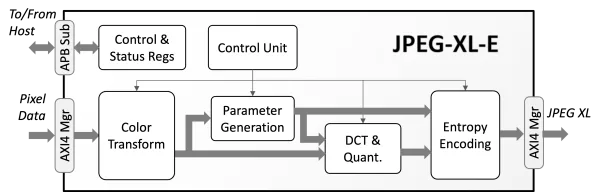
Designed for ease of integration, the encoder core operates autonomously once configured, requiring no further assistance from the host processor. It provides 64-bit AMBA® AXI manager interfaces for reading uncompressed image data and writing the compressed bitstream to system memory, as well as an APB3 subordinate interface for control and status register access.
JPEG-XL-E is designed with industry best practices, and its reliability has been proven through both rigorous verification and extensive prototype testing. Its deliverables include a complete verification environment and a bit-accurate software model.
Key features
JPEG XL Encoder
- Compliant to JPEG XL ISO/IEC 18181
- Lossy (Var-DCT) compression
- Supported Features
- Gaborish filter
- Quantization/Field value: 1-255
- Quantization/Scale value:
- arbitrary
- Quantization/Matrix value: Fixed
- DCT block size: 8x8, 16x8, 8x16
- TOC order: Fixed
- Entropy coding: Prefix code (fixed table value)
Input Format
- Horizontal Resolution: 320-4096
- Vertical Resolution: 16-4096
- Color format: LinearRGB,
- RGB (perceptual quantization)
- Bit depth: IEEE 754
- Single- or half-precision floating point
Throughput & Latency
- 1 sample/clock throughput
- 1 frame latency
Easy to Use and Integrate
- Processor-free, standalone operation
- AMBA® interfaces: 64-bit AXI4 manager for input samples and output compressed stream. 32-bit APB3 for CSR access
- Independent clock domains for the AXI4, APB3 and inner logic with clean CDC boundaries
- Microcode-free, LINT-clean, scan-ready design
Block Diagram
Applications
- The JPEG-XL-E core’s higher compression efficiency compared to legacy JPEG makes it well-suited to systems requiring high visual fidelity at reduced bandwidth or storage cost, while retaining support for modern imaging features such as high dynamic range, wide color gamut, and visually lossless coding.
- Applications include:
- Smartphones, digital still cameras, and consumer imaging devices
- Cloud media platforms and online image repositories
- Broadcast and professional imaging equipment
- Scientific and aerospace imaging
What’s Included?
- Source or encrypted RTL code
- Verification environment
- Sample simulation & synthesis scripts
- Software (C++) Bit-Accurate Model
- JPEG XL stream joining sample script
- Comprehensive user documentation
- IP-XACT register descriptions
Files
Note: some files may require an NDA depending on provider policy.
Specifications
Identity
Provider
Learn more about Image Conversion IP core
Nextreme Structured ASICs: An alternative for designing cost-optimized ARM926EJ processor-based embedded systems
Video Messaging for ARM7-based Cellular Chipsets.
Configurable Processors for Video Processing SOCs
Generating High Speed CSI2 Video by an FPGA
Viewpoint: Opportunity to win on different design fronts
Frequently asked questions about image conversion IP cores
What is JPEG XL Encoder?
JPEG XL Encoder is a Image Conversion IP core from CAST listed on Semi IP Hub.
How should engineers evaluate this Image Conversion?
Engineers should review the overview, key features, supported foundries and nodes, maturity, deliverables, and provider information before shortlisting this Image Conversion IP.
Can this semiconductor IP be compared with similar products?
Yes. Buyers can compare this product with similar semiconductor IP cores or IP families based on category, provider, process options, and structured technical specifications.