Vendor:
Chipus Microelectronics
Category:
Temperature Sensor
GP ULP Temperature Sensor - Built-in Sigma-Delta modulator – Low Quiescent Current - Silterra 0.18um
This macro-cell is an ultra-low-power, general purpose temperature sensor core.
Overview
This macro-cell is an ultra-low-power, general purpose temperature sensor core. This IP features a built-in Sigma-Delta modulator that is responsible to convert the analog signals to digital bit stream.
This IP requires an external 80nA bias current and a 200kHz clock signal.
The core is easily retargeted to any other CMOS technology because it uses typical devices of standard CMOS technologies.
Key features
- 10bit equivalent resolution
- Ultra low power consumption (8µA)
- Built-in Sigma-Delta modulator
- From -40°C to 125°C
Block Diagram
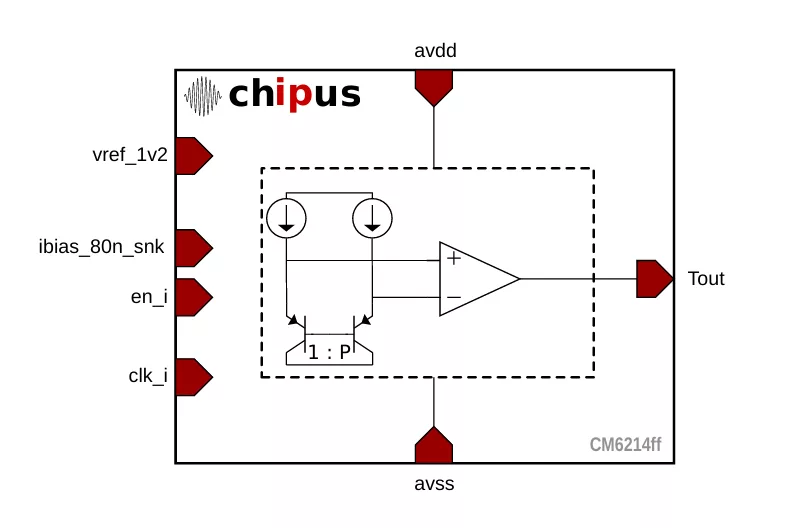
CM6214ff block diagram
Silicon Options
| Foundry | Node | Process | Maturity |
|---|---|---|---|
| Silterra | 180nm | G | — |
Specifications
Identity
Part Number
CM6214ff
Vendor
Chipus Microelectronics
Type
Silicon IP
Files
Note: some files may require an NDA depending on provider policy.
Provider

Chipus Microelectronics
HQ:
Brazil
Chipus Microelectronics (ISO 9001:2015 certified) is a semiconductor company focused on the development of mixed-signal ASICs, intellectual property (IP) blocks and IC design services.
The company has more than 200 analog IP blocks in process nodes from 22nm to 0.35um of various foundries. Since its foundation in 2008, Chipus has worked with customers worldwide (South and North America, Europe, and Asia) with firm commitment and flexible client support.
Besides analog and mixed-signal expertise, Chipus also offers custom digital IC design services having successfully delivered designs in FINFET technologies from RTL to backend.
Headquartered in Florianópolis, Brazil, Chipus has a US subsidiary in Silicon Valley and sales teams in both USA and Europe.
Learn more about Temperature Sensor IP core
Power Management for Internet of Things (IoT) System on a Chip (SoC) Development
There are many factors that must be considered when developing a custom System on a Chip (SoC) for Internet of Things (IoT) applications. Chief among these are the power management circuits on the die. Vidatronic offers this white paper to discuss these considerations and all of the various circuit blocks that can be found in this application. Vidatronic IP solutions are discussed and the benefits they bring to IoT SoC designers.
Smart Transit Solution
Surveillance and security has become increasingly important during modern days for government/law enforcement, public or private transit authorities and for the fleet management. To monitor or investigate accidental damage, theft, harassment or left packages, producing/collecting evidences and analyze the occurrence of situation is challenge. This white paper describes how smart transit solution can generate evidences and help in analyze the situation of an incident. Smart transit solution improves profitability by enabling batter safety, security and service.
High-Performance DSPs -> Voice control enhances appliance apps
High-Performance DSPs -> Voice control enhances appliance apps
Context Based Clock Gating Technique For Low Power Designs of IoT Applications - A DesignWare IP Case Study
This paper discusses about the intelligent low power techniques such as context based clock gating and how they are useful for IoT applications. It also describes how it improves the overall power efficiency of the system. The power statistics shared shows how the overall idle power and functional power consumption is significantly reduced. Further we discuss about how it can be combined with few other low power techniques to reduce the overall power
Custom ASICs for Internet of Industrial Things (IoIT)
This white paper commences with an overview of the IoIT (Internet of Industrial Things) opportunity, the market drivers, and how the semiconductor industry is responding to this need. We then include an example of a customisable SoC intended for use in various industrial applications where low power consumption, remote deployment, reduced production costs and short time-to-market are vital.
Frequently asked questions about Temperature Sensor IP cores
What is GP ULP Temperature Sensor - Built-in Sigma-Delta modulator – Low Quiescent Current - Silterra 0.18um?
GP ULP Temperature Sensor - Built-in Sigma-Delta modulator – Low Quiescent Current - Silterra 0.18um is a Temperature Sensor IP core from Chipus Microelectronics listed on Semi IP Hub. It is listed with support for silterra.
How should engineers evaluate this Temperature Sensor?
Engineers should review the overview, key features, supported foundries and nodes, maturity, deliverables, and provider information before shortlisting this Temperature Sensor IP.
Can this semiconductor IP be compared with similar products?
Yes. Buyers can compare this product with similar semiconductor IP cores or IP families based on category, provider, process options, and structured technical specifications.