Overview
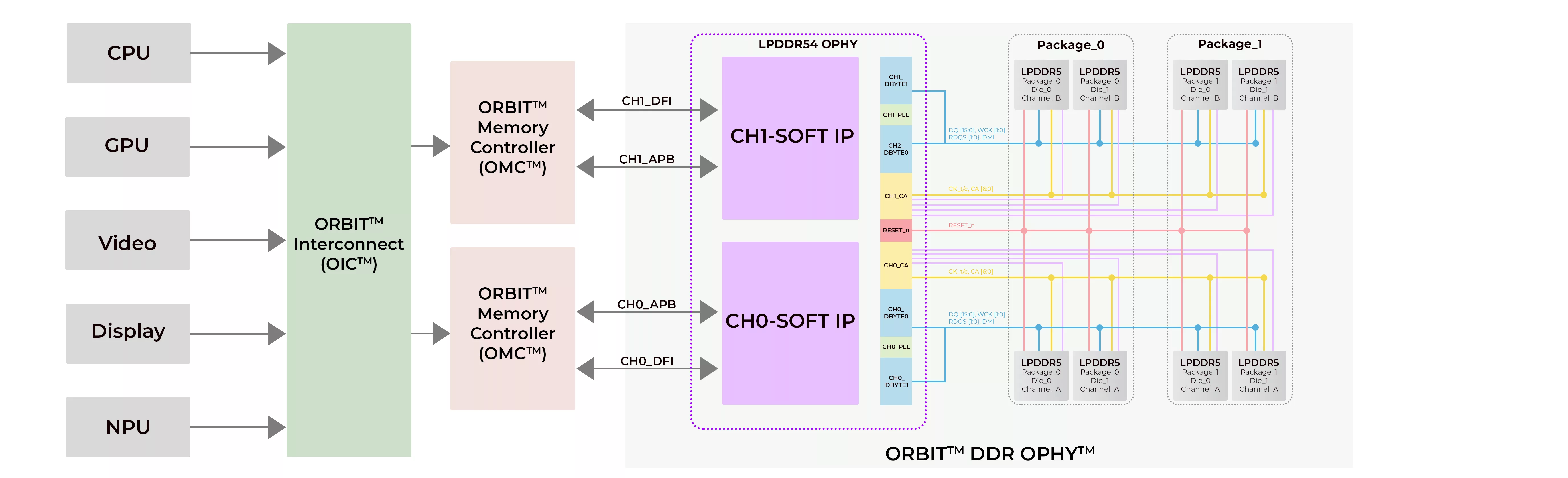
OPENEDGES, the memory system IP provider, including DDR memory controller, DDR PHY, on-chip interconnect, and NPU IP together as an integrated solution or independent IP. They are tightly combined to bring synergy for high performance and low latency. OPENEDGES' integrated IP solutions are market and silicon-proven, featuring advanced architectures and proprietary technologies that enable customers to shorten their design and verification processes.
The GDDR6 OPHY utilizes state-of-the-art architecture in full custom analog mixed-signal design to overcome the problem of long-term impedance drift and clock phase drift, allowing impedance and clock phase updates without interrupting data traffic. The programmable timing PHY boundary combines flexibility with analog precision, and the result is ultra-low PHY read/write latency between OMC and the GDDR6 DRAM without sacrificing performance.
The GDDR6 OPHY was designed at the system level with minimal package substrate layer and PCB layer count in mind. This enables the integration of a GDDR6 memory sub-system solution in cost-sensitive applications, such as consumer edge devices, AI, GPU, HPC, STB, SSD controllers, and application processors.
Learn more about GDDR IP core
This paper will include a short review of the key features of DDR, GDDR and MobileDDR memory architectures, covering power, speed and cost characteristics as well as key functionality differences that can impact overall system architecture. Using real system design experiences each of the main memory architectures will be used to address system design challenges of sustained bandwidth, reliability, access priority, power savings, and interface requirements.
Large Language Models (LLMs) have gained popularity in recent years, driving up the demand for inference. LLM inference is composed of two phases with distinct characteristics: a compute-bound prefill phase followed by a memory-bound decode phase. This paper proposes SPAD (Specialized Prefill and Decode hardware), adopting a less-is-more methodology to design specialized chips tailored to the distinct characteristics of prefill and decode phases.
HBM4 is the latest generation of the High Bandwidth Memory (HBM) that has become analogous to the Artificial Intelligence (AI) boom that is everywhere in today’s world. HBM is also increasingly being used in other applications like Data centers, autonomous driving systems, servers, cloud computing just to mention few domains where bandwidth and performance in a key requirement.
The rapid evolution of artificial intelligence (AI) is reshaping the technological landscape, driving unprecedented demands on computing infrastructure. At the heart of this transformation lie innovations in intellectual property (IP) that enable scalable, efficient, and performance-driven AI factories.
This white paper will discuss the design challenges that IC designers are facing when developing the new GDDR 7 high-performance memory interface and highlight some of the possible solutions to overcome these challenges, ensuring compliance and robustness of the GDDR7 memory interface.
The rapid evolution of artificial intelligence (AI) over the past decade has reshaped the way we interact with technology and transformed industries across the board. From early predictive models and voice assistants to today’s highly complex generative AI systems, we are witnessing the dawn of a new era: AI 2.0.