Overview
Attacks on digital circuits can occur when an attacker attempts to physically alter the device's internal components. These types of attacks are known as intrusive and can include actions such as probing or manipulating signals, adding or removing components, or modifying features on the chip.
To counteract these threats, Secure-IC has developed the Active Shield technology. This technology uses a protective mesh layer over the sensitive parts of the circuit, and actively monitors the mesh integrity for any signs of tampering. This countermeasure helps to safeguard the circuit's features and components, such as metal routing and transistors, from unauthorized access or modification through the front side of the device, such as:
- Wire micro-probing to read or force an equipotential
- Wire cutting (e.g., alarms, entropy source disconnection from a true random number generator…)
- Wire re-routing
- Burnt fuses opening
- ROM Altering
Active monitoring
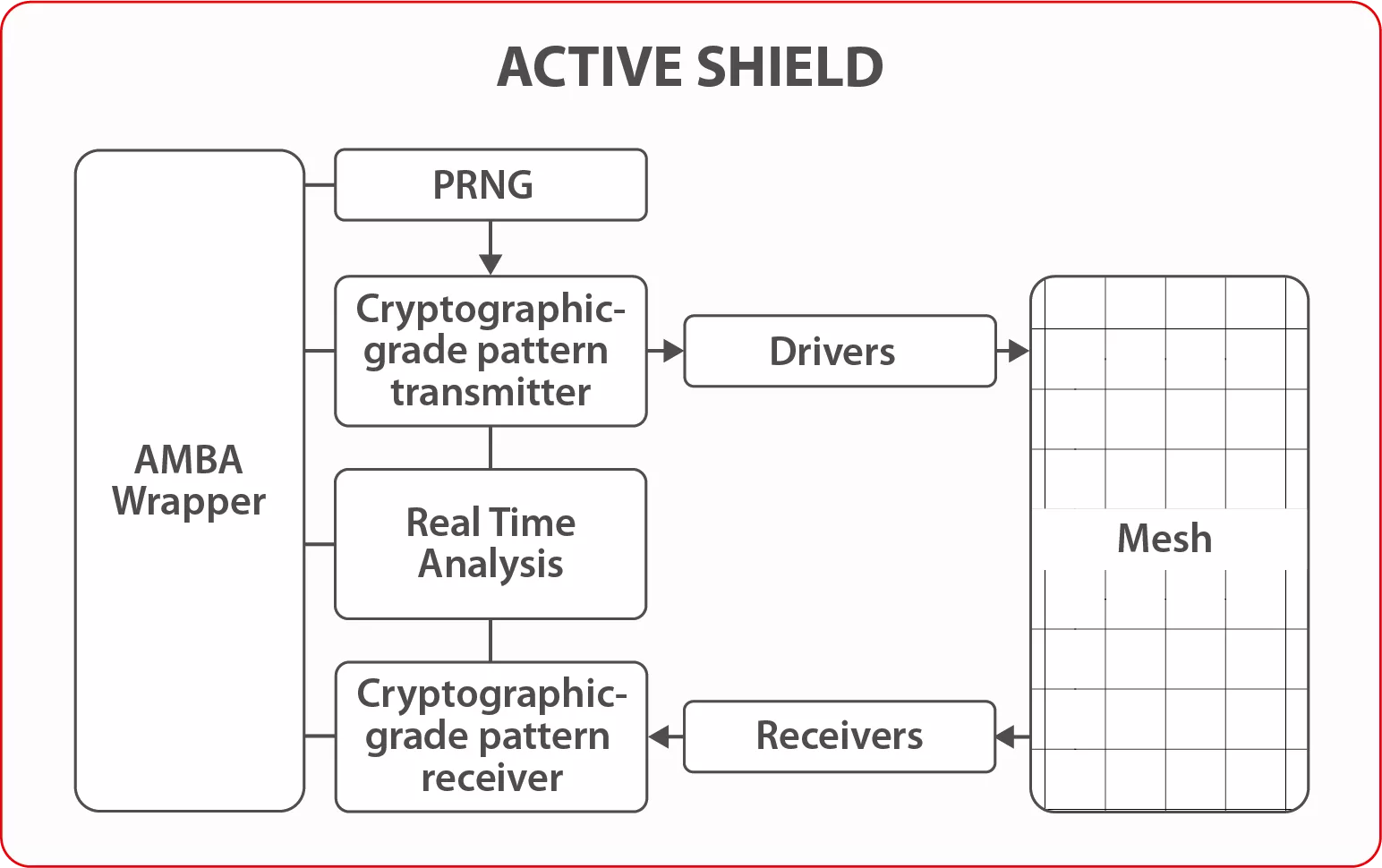
In order to further deter intrusive attacks, the mesh is actively monitored using random cryptographically generated patterns to detect integrity violations. By using this technology, modifying and rerouting the mesh becomes very costly as the attacker must reroute many wires to avoid detection. In addition, the data travelling through the shield mesh cannot be predicted by the attacker, because it is output by a cryptographic block cipher.
Active Shield technology relies on several submodules:
- A mesh created using a metal layer for wire routing
- Drivers and receivers used for electrical connection with the mesh
- A cryptographic-grade tamper detection module for monitoring the mesh integrity
Ideal for
Active Shield IP is ideal for:
- Protection against Bus probing
- Protection against FIB attacks
- Protection against wire micro-probing to read or force an equipotential
- Protection against wire cutting (e.g., alarms, entropy source disconnection from a true random number generator)
- Protection against wire re-routing
- Protection against ROM altering
Learn more about Fault Injection Protection IP core
As automotive displays become part of the safety surface, traditional host-dependent display architectures are showing their limits. In this article, Trilinear outlines how a RISC-V supervised DisplayPort subsystem can provide isolated control, deterministic fault handling, and a more auditable architecture for advanced automotive display platforms.
The automotive industry is undergoing the most significant transformation since the advent of electronics in cars. Vehicles are becoming software-defined, connected, AI-driven, and continuously updated. This evolution brings extraordinary new capability – but it also brings greater levels of cybersecurity and functional-safety risks.
Agile Analog’s tamper detection IP is a comprehensive set of sensors and monitors designed to detect a wide variety of physical attacks and side-channel attacks (SCAs). T
Adaptability is essential for digital twin systems due to constantly evolving environments – Learn how eFPGA hardware enables robust and adaptable systems
Have you ever wondered how secure critical systems, like medical devices, aerospace systems or autonomous cars, really are when it comes to data protection? One point of the answer lies in effective and robust key management. Cryptographic keys are the digital secrets underpinning device identity, data confidentiality, secure communication, and overall system trustworthiness.
The hardware root of trust (HRoT) provides the trust base (root key), hardware identifier (UID), hardware unique key (HUK), and entropy required for the secure operation of the entire chip and therefore is often the focus of hacker attacks. If the design can’t effectively resist attacks, hackers can easily obtain the secrets of the entire chip. Attackers can use the secrets to crack identity authentication and data encryption and steal product design know-how, causing application security problems.