Vendor:
TES Electronic Solutions
Category:
Display Controller
Customizable Display Controller IP
CDC is a fully Customizable Display Controller IP supporting up to 16k resolutions (4096x4096 pixel) on a MIPI-DPI compliant para…
Overview
CDC is a fully Customizable Display Controller IP supporting up to 16k resolutions (4096x4096 pixel) on a MIPI-DPI compliant parallel video output. Several features can be configured at synthesis time and programmed at run time. The display controller can be applied to e.g. FPGA systems with a resource optimized, application specific feature configuration or to ASIC projects applying a more generic feature set and thus more flexibility.
The main functionality of CDC is reading images (layers) from memory, combining them on-the-fly e.g. by blending, cropping and windowing and generating a pixel output stream of the combined image. The CDC supports image composition as well as partial screen updates.
On the output the controller provides a digital RGB signal (or optionally a digital component YCbCr signal) with video data and signals for horizontal/vertical blank and synchronization. The output interface is compliant with the MIPI-DPI standard and can be easily connected with any video output controller like HDMI, MIPI-DSI, 3G-SDI or a Video DAC. Optionally, the composed image can be written back to memory.
CDC Configurability
Based on a highly modular architecture the CDC-Family offers a wide range of features from CDC-200 providing basic functionality with each family member offering additional configurable feature extensions up to the flag-ship CDC-500 which supports output image rotation. The features are configurable at design-time and can be controlled at run-time via an simple basic driver for register agnostic control or a Khronos standard OpenWF Display API driver.
The following table outlines the set of configurable features for all CDC-Family members:
| Feature | CDC-200 | CDC-300 | CDC-400 | CDC-500 |
|---|---|---|---|---|
| Layer Blending | x | x | x | x |
| Windowing | x | x | x | x |
| Gamma Correction | x | x | x | x |
| Color Keying | x | x | x | x |
| Dithering | x | x | x | x |
| Layer CLUT | x | x | x | x |
| RGB/Greyscale Input Formats | x | x | x | x |
| RGB888 Output | x | x | x | x |
| Mirroring (H & V) | x | x | x | x |
| Dual View | x | x | x | |
| Scaling | x | x | x | |
| YCBCR Input Formats | x | x | x | |
| YCBCR Output Formats | x | x | ||
| Programmable Layer Blending Order | x | x | ||
| Missed-Pixel Handling | x | x | ||
| Single Frame Mode | x | x | ||
| Dual CPU Support | x | x | ||
| Frame CRC | x | x | ||
| Rotation | x | |||
| Composition Capture | x |
Application Example
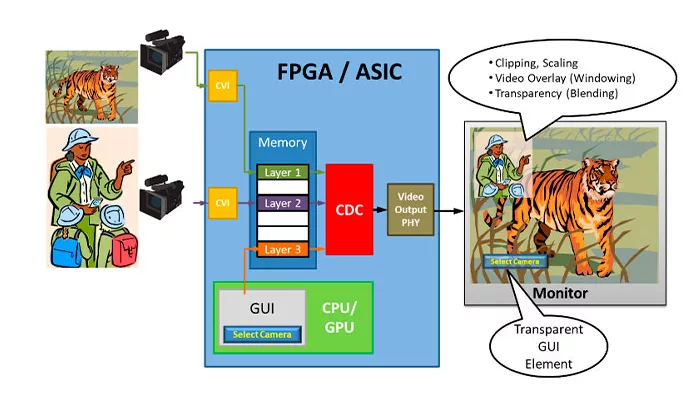
In this example, images from two video cameras are transferred to frame buffers in memory using two CVIs (Configurable Video Input controller, another TES IP), while the internal CPU/GPU generates GUI elements to be used in the displayed image in a 3rd framebuffer. The CDC clips and scales the image stored in layer 2 and blends it with the main image on layer 1, using windowing to display it in the upper left corner, while adding some transparency to keep the occupied part of the main image visible. The GUI element is blended into the lower left corner, again using the transparency feature of the CDC.
The resulting image is transferred as RGB888 pixel stream to a Video PHY block, which provides a standard video display interface (e.g. MIPI, DVI, HDMI, ...) suitable for the attached monitor.
Key features
- Layer Blending
- Windowing
- Gamma Correction
- Color Keying
- Dithering
- Layer CLUT
- RGB/Greyscale Input Formats
- RGB888 Output
- Dual View
- Scaling
- Mirroring (H & V)
- YCBCR Input Formats
- YCBCR Output Formats
- Layer Blending Order
- Missed-Pixel Handling
- Single Frame Mode
- Dual CPU Support
- Frame CRC
- On the fly 90° or 270° rotation
Block Diagram
CDC block diagram
Files
Note: some files may require an NDA depending on provider policy.
Specifications
Identity
Part Number
CDC
Vendor
TES Electronic Solutions
Type
Silicon IP
Provider

TES Electronic Solutions
HQ:
Germany
TES Electronic Solutions is a global electronic technology and services company offering innovative solutions and custom electronic design as well as a blend of hardware (for ASICs and FPGAs) and software IP. Besides designing customer specific systems or sub-systems that are optimized to customers’ applications, TES also develops licensable wireless, graphics,GUI, video-IO and multimedia IP accelerating time to market.
From its design centers in Germany, and with its broad expertise in GUI concepts, industrial design, hardware-, software-, FPGA- and ASIC-development TES provides innovative solutions in the areas of RF / wireless, professional multimedia, embedded graphics and RF / mixed-signal ASICs.
TES serves a wide range of customers from well-known highly specialized middle-size companies to global market leaders.
Learn more about Display Controller IP core
Empowering AI-Enabled Systems with MIPI C/D-PHY Combo IP: The Complete Audio-Visual Subsystem and AI
High Speed, Low Power and Flexibility Drive DisplayPort's Increasing Popularity
In this article we provide an introduction to DP, talk about the various factors that IC designers will want to consider when integrating the DP functionality into their SOC, and present at a high-level the solutions Silicon Creations provides in this area.
The whys and hows of secure boot
With the proliferation of Internet of Things (IoT) devices, which now span just about every walk of life, from smart cities to wireless jewellery, the need to prioritize security in IoT-style embedded systems has never been greater. The secure boot process is a vital first step in securing any embedded system, a necessary part of your application’s anti-malware fortress. Let’s take a look at the pros and cons, with a focus on one of the most popular processors in electronics – the i.MX6.
Motion Picture: a Reality on Emulation Platform
In present day’s situation, whenever we are in the phase of designing a cluster SoC, we have no reliable way of verifying our design in real case scenarios, or showcase the possibilities of our design through any demos. This, sometimes, paves way for critical design bugs which requires re-spins/cuts.
Sequential clock gating maximizes power savings at IP level
In this paper we talk about design exploration using the PowerPro tool. For analysis of power optimization based on this tool, we have included Advanced Driver Assistance System (ADAS) and cluster IPs with high speed processing requirements. These IPs have multiple complex operation requirements within a clock period, making them ideal candidates for power saving. The IPs under consideration are image processors, high-speed bus fabrics for a memory controller, display controllers, and video codecs.
Frequently asked questions about Display Controller IP
What is Customizable Display Controller IP?
Customizable Display Controller IP is a Display Controller IP core from TES Electronic Solutions listed on Semi IP Hub.
How should engineers evaluate this Display Controller?
Engineers should review the overview, key features, supported foundries and nodes, maturity, deliverables, and provider information before shortlisting this Display Controller IP.
Can this semiconductor IP be compared with similar products?
Yes. Buyers can compare this product with similar semiconductor IP cores or IP families based on category, provider, process options, and structured technical specifications.