Vendor: CSEM Category: Edge AI Accelerator

AI/ML Accelerator

Hierarchical scalability is the foundation principle of the Fibonacci machine-learning (ML) system-on-chip (SoC).

Overview

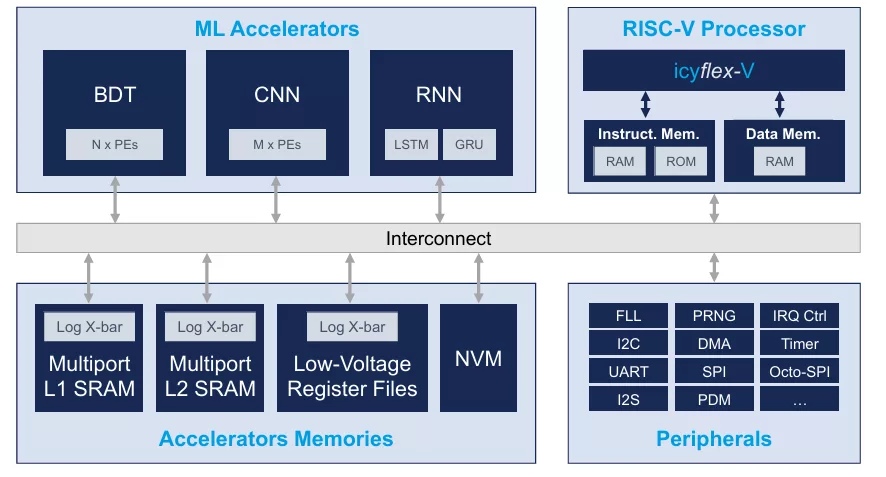
Hierarchical scalability is the foundation principle of the Fibonacci machine-learning (ML) system-on-chip (SoC). Like the Fibonacci number series, combining each element by the sum of the previous ones, the SoC can dynamically increase its computational performance by adding accelerator resources based on the application’s needs. Its heterogenous architecture features a low power time-series ML accelerator (FETA), two clusters of highly parallelized neural processing units (NPU), energy-optimized on-chip memories, a flexible RISC-V microcontroller core, and a rich set of peripherals for easy system integration. Trained models can be deployed through the ML compiler, supporting all common formats (e.g. ONNX).

NPU Clusters

  • Optimized for spatial neural networks (e.g. CNNs, ResNets, MobileNets)
  • Sparsity exploitation
  • Peak MAC performance: 960 GOPS

FETA Cluster

  • Optimized for temporal neural networks (e.g. RNNs like LSTM or GRU)
  • Smart temporal feature extraction engine

Key features

  • General purpose RISC-V core (RV32IMC)
  • Standard communication peripherals: UART, I2C, SPI (x2), Octo-SPI, DCMI, I2S
  • JTAG debugging interface
  • Up to 4 MB of on-chip SRAM + 0.5MB of MRAM
  • Multi neural network execution
  • Selective execution and early exit
  • Dynamic precision scaling
  • Dynamic power switching
  • Bank and block level power gating
  • Flexible DMA engines (x2)
  • Power consumption: 100 uW - 500 mW

Block Diagram

Applications

  • Multi-modal concurrent data analysis from different sensor types (e.g. audio-visual sensor fusion)
  • Multi-stage evaluation: hierarchical execution with increasing complexity to reduce average power consumption.
  • Low power edge processing, down to uW power budgets
  • Spatial and time-series signal analysis

Files

Note: some files may require an NDA depending on provider policy.

Specifications

Identity

Part Number
Fibonacci
Vendor
CSEM

Provider

CSEM
HQ: Switzerland
CSEM is one of Europe’s leading low power ASIC design providers. With roots in the Swiss watch industry, CSEM is today an acknowledged reference in the fields of ultra low power and low-voltage analog, digital and mixed-signal ASIC design. Our strengths include: • Low power, low voltage RF & analog IC and SoC (e.g. 2mA Rx current radio) • Ultra low power RISC cores (e.g. 6µW/MHz in 65nm) • Smart vision sensors with edge computing • System-on-Chip integration & embedded software development Our expert designers have proven experience in translating customer requirements into high-quality ASIC designs to optimize cost, performance and time-to-market in close cooperation with the customer. Our proven design flow is complemented by state of the art design tools and measurement equipment to ensure quality and on-time delivery. CSEM provides a flexible engagement model, ranging from licensing of our ultra low power IP’s (e.g. icyflexTM 32-bit MCU/DSP core, low-leakage memories, etc) and customized analog IP block design for semiconductor vendors, through to full-custom ASIC and SoC design and delivery. Our fabless production service offers industrialization, test, qualification and small series production. We work with most of the major foundries, and cover technology nodes from 0.25µm down to 22nm CMOS. Served markets include portable medical, industrial, consumer, home automation and automated meter reading.

Learn more about Edge AI Accelerator IP core

RISC-V Based TinyML Accelerator for Depthwise Separable Convolutions in Edge AI

While lightweight architectures like MobileNetV2 employ Depthwise Separable Convolutions (DSC) to reduce computational complexity, their multi-stage design introduces a critical performance bottleneck inherent to layer-by-layer execution: the high energy and latency cost of transferring intermediate feature maps to either large on-chip buffers or off-chip DRAM. To address this memory wall, this paper introduces a novel hardware accelerator architecture that utilizes a fused pixel-wise dataflow.

Accelerating Your Development: Simplify SoC I/O with a Single Multi-Protocol SerDes IP

Enter the Multi-Protocol SerDes (Serializer/Deserializer)—a flexible, reusable IP block that allows a single PHY to support multiple serial communication protocols, such as PCIe, SATA, Ethernet, USB, and more. This approach enables SoC vendors to meet diverse customer requirements and application needs without redesigning I/O for each target market.

Frequently asked questions about Edge AI Accelerator IP cores

What is AI/ML Accelerator?

AI/ML Accelerator is a Edge AI Accelerator IP core from CSEM listed on Semi IP Hub.

How should engineers evaluate this Edge AI Accelerator?

Engineers should review the overview, key features, supported foundries and nodes, maturity, deliverables, and provider information before shortlisting this Edge AI Accelerator IP.

Can this semiconductor IP be compared with similar products?

Yes. Buyers can compare this product with similar semiconductor IP cores or IP families based on category, provider, process options, and structured technical specifications.

×
Semiconductor IP