Vendor:
Comsis
Category:
Wi-Fi
802.11ax PHY Layer C Floating-Point Code IP for the STA mode
This IP includes a recommendation-compliant 802.11ax PHY layer C floating-point code for the Station (STA) mode.
Overview
This IP includes a recommendation-compliant 802.11ax PHY layer C floating-point code for the Station (STA) mode. The code is integrated into a simulation environment that allows the configuration of mandatory features and the performance evaluation in terms of frame error rate. It is designed to generate fixed-point sequences in order to accelerate the development of both C fixed-point code and HDL code for prototyping environments.
The code does not include proprietary libraries or ROS dependencies, and can therefore be easily integrated into any C-based simulation environment.
Architecture overview
- Reusable and substitutable functionalities (CC, interleaver/deinterleaver, parser/deparser, mappings, etc. …).
- Common info parameters configuration (length size, HE LTF modes, guard interval size, AP transmission power, …).
- User info parameters configuration (MCS, number of spatial streams, Resource Unit (RU) allocation, Association Identifier Definition (AID), RSSI target, etc.
- Adjacent RU allocations and RU allocations across successive frames can be configured to increase the available resources for a given STA.
Target applications
- Academic and industrial research on WLAN next generations.
- Validation of platforms and reference design for HDL code.
- PHY layer rapid prototyping in FPGA or ASIC platforms.
Use cases
- Dense networks: OFDMA avoids collisions, reduces latency, and provides better spectral efficiency.
- IoT devices: these require narrow dedicated subchannels, low data rates, and power saving options − all integrated in an optimised device size.
- Public Wi-Fi spaces: these demand variable traffic handling enabled by flexible RU allocation.
- Real time applications: the trigger control frame from the Access Point synchronises the simultaneous uplink transmissions of STAs, reducing latency and improving the Quality of Service (QoS).
- Industrial automation: this requires low latency and long-range transmissions enhanced by continuous channel estimation using midambles.
Key features
- High-enhanced single user (HE SU), high-enhanced extended-range single user (HE ER SU), high-enhanced trigger-based (HE TB) PPDU formats and trigger control frame.
- OFDM, uplink OFDMA (RU = 26, 52, 106, 242) and MU-MIMO
- 16, 32 and 64 guard intervales
- 1x, 2x and 4x HE-LTF modes
- HE-LTF field with up to 8 HE-LTF OFDM symbols
- MCS from 0 up to 7
- 20 MHz bandwidth
- Up to 2 spatial streams
- Midamble support
- Convolutional coding (CC) and hard Viterbi decoding, OFDM modulation/demodulation, Tx/Rx filtering, preamble detection, frequency and time synchronisations, channel estimation and compensation up to 4 spatial streams, tracking estimation and compensation (estimations enhanced using midambles).
Block Diagram
802.11ax PHY Layer C Floating-Point Code IP for the STA mode block diagram
Benefits
- Toolchain agnostic C code
- Code is divided in reusable and easily substitutable modules
- Scalable solution (bandwidth, number of spatial streams up to 4, MCS, etc.)
- Fully programmable simulator
- On demand customisation available
- Fixed-point sequences are generated to be used as references in fixed-point code developments.
Applications
- Spectral efficiency
- Reduced latency
- Power saving
- Improved QoS
- Miniaturisation
- Long range environment
What’s Included?
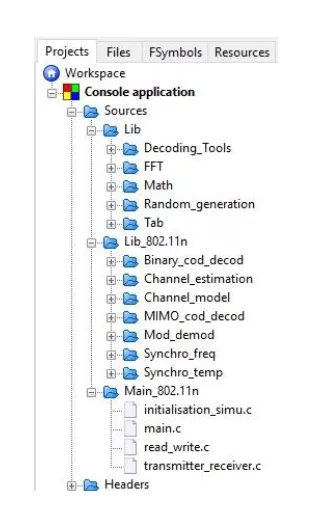
- C floating-point code and project scripts for CodeBlock
- Programmable simulation environment to check performances with several channel models
- User guide
- Support
Files
Note: some files may require an NDA depending on provider policy.
Specifications
Identity
Part Number
802.11ax PHY Layer C Floating-Point Code IP for the STA mode
Vendor
Comsis
Type
Silicon IP
Provider

Comsis
HQ:
France
Comsis, is a Paris-based company specialized in the development of Wi-Fi Intellectual properties (IPs).
Founded and led by CEO Philippe Leclair, Comsis has developed breakthrough and hardware agnostic & silicon proven IPs solutions that address the challenges of Wi-Fi evolution and 5G convergence.
Comsis Wi-Fi technology has direct and immediate commercial applications in indoor and outdoor environments. It includes Internet access, secure IoT, factory 4.0, coverage of long range dead-zones, highly secure networks with very high quality of service protocols and low power consumption of its IPs architecture.
Given the range of applications and the massive increase in connected devices projected over the coming years, where Wi-Fi will play a major role, the total addressable market for Comsis is significant.
Learn more about Wi-Fi IP core
Wi-Fi 7 (IEEE 802.11be) & MLO vs. Wi-Fi 6/6E (IEEE 802.11ax): What to Ask for Optimal Design Considerations
Franz Dugand, Ceva
How to achieve better IoT security in Wi-Fi modules
A look at the architecture of Wi-Fi modules and the opportunities for designers to improve IoT device and network security by using the resources available in these modules.
Designing a Wi-Fi HaLow Baseband in Less than Six Months
Protecting Wi-Fi chipsets with hardware-based security cores
CEVA's XC12 DSP Core Targets Multi-Gbit Cellular, Wi-Fi Opportunities
Frequently asked questions about Wi-Fi IP cores
What is 802.11ax PHY Layer C Floating-Point Code IP for the STA mode?
802.11ax PHY Layer C Floating-Point Code IP for the STA mode is a Wi-Fi IP core from Comsis listed on Semi IP Hub.
How should engineers evaluate this Wi-Fi?
Engineers should review the overview, key features, supported foundries and nodes, maturity, deliverables, and provider information before shortlisting this Wi-Fi IP.
Can this semiconductor IP be compared with similar products?
Yes. Buyers can compare this product with similar semiconductor IP cores or IP families based on category, provider, process options, and structured technical specifications.