
Vendor: NTLab Category: EEPROM

1KByte EEPROM IP with configuration 66p16w8bit

130GF_EEPROM_04 is a nonvolatile electrically erasable programmable read-only memory (EEPROM) with volume 1056 Byte (8(bit per wo…

GlobalFoundries 130nm BCD Pre-Silicon View all specifications

Overview

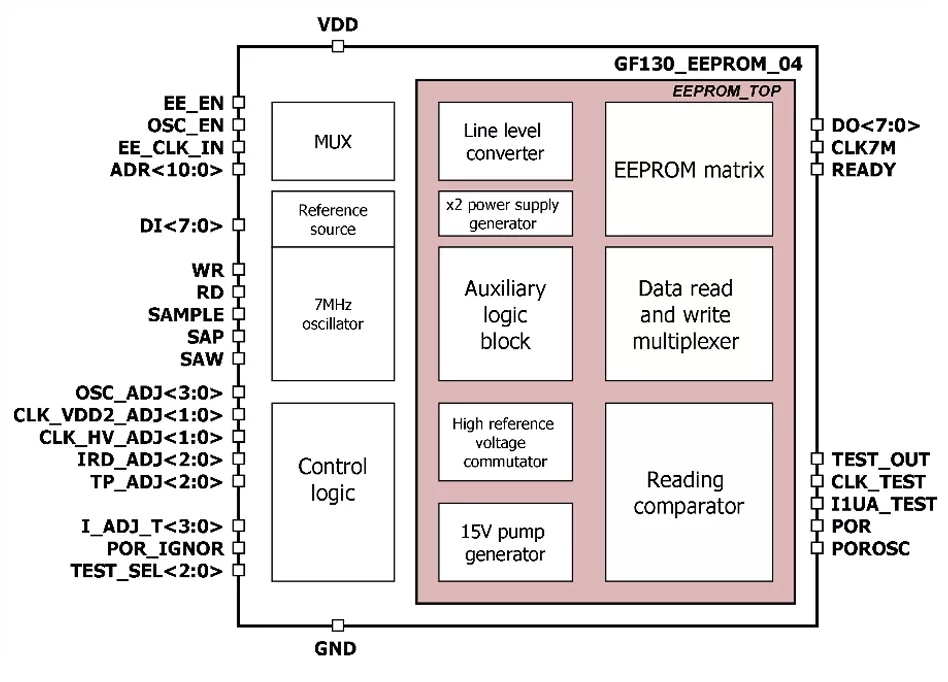
130GF_EEPROM_04 is a nonvolatile electrically erasable programmable read-only memory (EEPROM) with volume 1056 Byte (8(bit per word) x 16(words per page) x 66(pages)) with parallel write&read data in one word.
Write EEPROM data comes to input DI<7:0> and write process execute if signal WR=“1”.
Data DI<7:0>, page address ADR_P<6:0>, word address in page ADR_W<3:0> are latched into internal registers and cannot be changed until the end of the writing process. At the end of the writing, the READY = “1” flag is set.
Data reading is carried out by specifying the page address ADR_P<6:0> and the address of the word in the page ADR_W<3:0>. After applying the reading strobe, the DO<7:0> signal is set at the output corresponding to the reading data from the corresponding addresses of the EEPROM cell.
EEPROM also has a 7MHz gated clock cell output (glitchless start) from a built-in oscillator. The oscillator has frequency control inputs to compensate for process variation. Memory is optimized for usage in the industrial and commercial applications, requiring low power consumption and supply voltage.

Key features

  • Global Foundries Embedded EEPROM 0.13 um
  • 1056 Byte of available memory 8(bit per word) x 16(words per page) x 66(pages) bit
  • High density of memory cells
  • Writing and erasing data by one high-voltage pulse
  • Programming and erase time – 2 ms each
  • Page writes allowed
  • Data retention and endurance cycles determined by GF technology
  • Low power dissipation in standby and active mode
  • Built-in 7MHz oscillator

Block Diagram

Applications

  • Access control systems
  • Radio-frequency identification systems, smart cards
  • Electronic devices with battery power
  • Chip serial ID and chip safety

What’s Included?

  • Schematic in electronic format (.netlist file)
  • Layout in GDSII electronic format (.gds file)
  • Abstract view in electronic format (.lef and .lib files)
  • DRC, LVS, antenna reports in electronic format (.summary, .report files)
  • Datasheet in electronic format (.pdf file)

Files

Note: some files may require an NDA depending on provider policy.

Silicon Options

Foundry Node Process Maturity
GlobalFoundries 130nm BCD Pre-Silicon

Specifications

Identity

Part Number
130GF_EEPROM_04
Vendor
NTLab
Type
Silicon IP

Provider

NTLab
HQ: Lithuania
NTLab is a vertically integrated microelectronics design center. It has 70+ experienced and qualified engineers. NTLab specializes in the designing of mixed-signal and RF ICs and Systems-on-Chip. It has a wide range of own silicon-verified IP blocks: processor cores, interfaces, analog and high-frequency PHYs, etc., thus allowing customized design to be fast and predictable. In-company unique combination of competences in digital, analog and RF circuits and embedded software enables NTLab to participate in the projects that require deep research and utilize most sophisticated and advanced techniques: multi-system GPS/GLONASS/Galileo/BeiDou/NavIC(IRNSS)/QZSS/SBAS navigation, RF ID, wireless communications, etc. All designed ICs are provided with test and development tools, as well as with reference software. NTLab offers a wide range of silicon proven analog/mixed-signal IPs in 0.35µm, 0.25 µm, 0.18 µm, 0.13 µm, 0.09 µm, 65nm, 55nm, 40nm, 28nm, 22 nm CMOS and SiGe BiCMOS processes. These IPs are suitable for devices targeted both consumer and industrial markets. Most of these IPs have been proven in silicon on the foundries: Samsung, UMC, GlobalFoundries, SMIC, VIS, Tower, X-FAB, iHP, AMS, SilTerra, STMicroelectronics, Winfoundry.

Learn more about EEPROM IP core

Unleashing EEPROM Potential by Going Embedded: Introducing eMemory's NeoEE

EEPROM memory, which recently celebrated its 50th birthday, continues to defy obsolescence. Despite its age, EEPROM remains a mature, reliable, and affordable technology for many electronic systems. As IC designers embed EEPROM onto chips, it has become an integral part of chip design, offering essential benefits to applications such as MCU, PMIC, sensors, and RFID tags.

Understanding Physical Unclonable Function (PUF)

A growing number of ASICs, microcontrollers and SoCs embed hardware cryptographic accelerators or software cryptographic libraries. The emergence of the Internet of Things (IoT) will call for an even faster adoption. We now can talk about cryptography pervasion.

Types of Storages for Computing System-On-Chips

We are living in an age where we generate the same amount of data each year that has been generated since antiquity. Ever wondered how and where these peta /exa/zetta bytes of data are stored?

CSoC Platform / Digital Subsystem IP for IoT

This paper describes a CSoC platform and configurable digital subsystem IP which can be deployed for development of IOT edge devices. The paper encompasses the different attributes of IOT edge device that can cater multiple industry segments, key features and benefits of CSoC platform, components of the digital subsystem IP that enables rapid prototyping of SoCs for IOT applications.

The future of the 8051 legacy upgraded for the Internet of Things (IoT)

The Internet of Things (IoT) is the latest buzzword driving the industry for any number of low-power interconnected things. However, the IoT encompasses an incredible number of different types of things ranging from edge objects, namely smart or wearable devices which are battery powered with sensors and wireless connectivity, through aggregation nodes, namely hubs, routers and gateways for data aggregation, up to information processing servers in the Cloud to handle the data pushed by edge objects.
Frequently asked questions about EEPROM IP cores

What is 1KByte EEPROM IP with configuration 66p16w8bit?

1KByte EEPROM IP with configuration 66p16w8bit is a EEPROM IP core from NTLab listed on Semi IP Hub. It is listed with support for globalfoundries Pre-Silicon.

How should engineers evaluate this EEPROM?

Engineers should review the overview, key features, supported foundries and nodes, maturity, deliverables, and provider information before shortlisting this EEPROM IP.

Can this semiconductor IP be compared with similar products?

Yes. Buyers can compare this product with similar semiconductor IP cores or IP families based on category, provider, process options, and structured technical specifications.

×
Semiconductor IP