Vendor: Fraunhofer Institute Integrated Circuits and Systems (IIS) Category: ADC

12 Bit 20 MS/s Pipeline ADC on XFAB XH035

This pipelined ADC can be applied for up to 20MSps sampling frequencies.

Overview

This pipelined ADC can be applied for up to 20MSps sampling frequencies. By using interleaved switched-capacitor circuitries a CLK signal with half the sampling rate needs to be applied.

This ADC is built as a single-ended architecture and is designed to convert input signals from 0.5 – 2.3V at 3.3V supply voltage with up to 10 MHz input bandwidth with 12 bits resolution.

The ADC IP includes reference voltage generation with buffers and optional high-precision bandgap reference. The accuracy of the ADC is ensured by one-time-trimming of the reference voltages. Power-down mode is available.

The ADC is silicon proven using the XFAB XH035 process. Measurement results and samples are available.

Fraunhofer IIS provides a detailed documentation and
support for the IP integration. Modifications, extensions and technology ports of the IP are available on request

Key features

  • Resolution: 12 bit
  • Conversion rate: up to 20 MS/s
  • Power consumption: 125 mW @ 3.3 V
  • Integral non-linearity: +/- 2.0 LSB
  • Diff. non-linearity: +/- 0.7 LSB
  • Supply voltage: 3.0 V – 5.0 V
  • Input voltage range: 0.5 - 2.3 V
  • Operating temperature: 0 – 85 °C

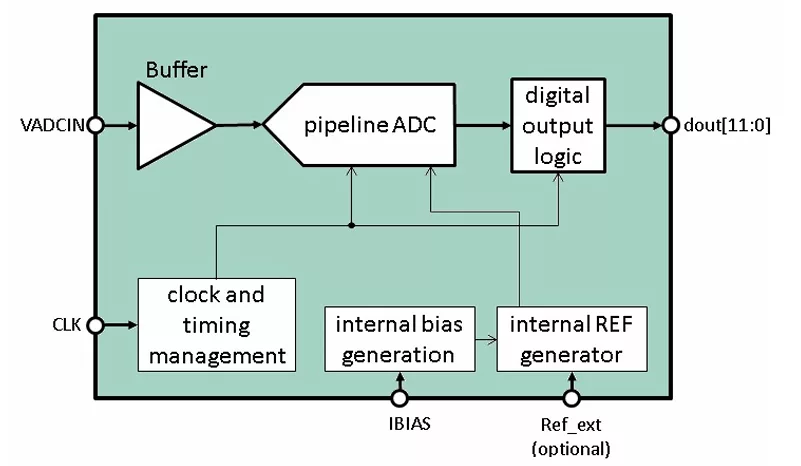
Block Diagram

Benefits

  • Accelerated design service
  • Design safety (first-time-right)
  • Customer-specific flexible IPs
  • Automated DfR and verification

Applications

  • IoT
  • Medical
  • Consumer
  • Automotive (on request)
  • Industrial (on request)

What’s Included?

  • GDSII data
  • Simulation model
  • Documentation
  • Integration and customizing support

Files

Note: some files may require an NDA depending on provider policy.

Specifications

Identity

Part Number
ADC12b020MS350nm
Vendor
Fraunhofer Institute Integrated Circuits and Systems (IIS)

Provider

Fraunhofer Institute Integrated Circuits and Systems (IIS)
HQ: Germany
The Fraunhofer Institute for Integrated Circuits (IIS) offers core components for ASIC and FPGA solutions. The cores are developed by Fraunhofer IIS in Erlangen, Germany and selected partners. Over 25 years of system and design know-how, analog and digital design experience, and the needs of our customers have influenced the methodology to develop these cores. Each core has been verified with sophisticated test procedures at Fraunhofer IIS before it is offered to the customers. As a result, the cores are of high quality and proven technology. Many components are parameterizable and allow the designer to tailor each component to the needs of the application. Therefore, using our components saves lots of design and verification effort.

Learn more about ADC IP core

Uncertainty-Guided Live Measurement Sequencing for Fast SAR ADC Linearity Testing

This paper introduces a novel closed-loop testing methodology for efficient linearity testing of high-resolution Successive Approximation Register (SAR) Analog-to-Digital Converters (ADCs). Existing test strategies, including histogram-based approaches, sine wave testing, and model-driven reconstruction, often rely on dense data acquisition followed by offline post-processing, which increases overall test time and complexity.

Three ways of looking at a sigma-delta ADC device

The growing availability of digital ICs like microcontrollers, microprocessors, and field-programmable gate arrays (FPGAs) allows developers to use complex digital processing techniques rather than analog signal conditioning. For this reason, analog-to-digital converters (ADCs) have become a widely-used component in mixed-signal circuits.

Specifying a PLL Part 1: Calculating PLL Clock Spur Requirements from ADC or DAC SFDR

In high end RF systems, such as 5G radios, the requirements are so stringent that the source of this strongest unwanted tone can be the PLL. This article outlines how spurs in the input clock to the ADC or DAC may limit the SFDR. This in turn will set the requirements for the spurs for the input clock (from a PLL), in order to achieve a specific SFDR.

Save power in IoT SoCs by leveraging ADC characteristics

Power-sensitive applications such as Internet-of-Things (IoT) require a comprehensive power savings strategy within the system-on-chip (SoC). Techniques relying solely on the use of traditional power down modes and low supply voltage may not be enough to achieve the required power targets. The analog block is often assumed to be too sensitive and not compatible with aggressive power management techniques.

High Speed ADC Data Transfer

When continuously running a high speed ADC, it can be a challenge to deal with the firehose of raw data available at the output. To use City Semiconductor’s 2.5 GS/s 12-bit ADC, for example, 30 gigabits per second of data have to be accepted.

Frequently asked questions about ADC IP cores

What is 12 Bit 20 MS/s Pipeline ADC on XFAB XH035?

12 Bit 20 MS/s Pipeline ADC on XFAB XH035 is a ADC IP core from Fraunhofer Institute Integrated Circuits and Systems (IIS) listed on Semi IP Hub.

How should engineers evaluate this ADC?

Engineers should review the overview, key features, supported foundries and nodes, maturity, deliverables, and provider information before shortlisting this ADC IP.

Can this semiconductor IP be compared with similar products?

Yes. Buyers can compare this product with similar semiconductor IP cores or IP families based on category, provider, process options, and structured technical specifications.

×
Semiconductor IP