Overview
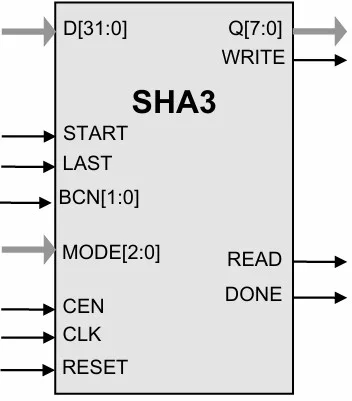
The SHA cores provide implementation of cryptographic hashes “Keccak” SHA-3 (cores SHA3-224, SHA3-256, SHA3-384 and SHA3-512) and (optionally) the corresponding hash-based HMAC, KMAC, and XOF (SHAKE) functions
The cores utilize “flow-through” design that can be easily included into the data path of a communication system or connected to a microprocessor: the core reads the data via the D input and outputs the hash result via its Q output. Data bus widths for both D and Q are parameterized.
The design is fully synchronous and is available in both source and netlist form.
Function Description
The SHA-3 algorithms process data in block of different size that depends on the particular algorithm:
| Hash |
Block size("bitrate") |
| SHA3-224 |
1152 |
| SHA3-384 |
832 |
| SHA3-256 |
1088 |
| SHA3-512 |
576 |
The Secure Hash Standard (SHA-3) is a message digest standard as defined in the FIPS-202 publication
http://nvlpubs.nist.gov/nistpubs/FIPS/NIST.FIPS.202.pdf .
The core is designed for flow-through operation. The input data can contain any number of bytes up to 229 (data padding is performed inside the core). The output data is the 224/256/384/512-bit hash or HMAC value.
Learn more about Hash / MAC IP core
A complete reinvention of the automotive industry is currently underway. Autonomous driving, connected vehicles, and the electrification of the powertrain all represent a once-in-a-generation shift in the manufacturing process.
Explore the significance of cryptographic hash functions in embedded security, their common algorithms, and practical choices for FPGA-based systems.
TLS 1.3 offers attractive speed and security improvement benefits that are hard to ignore. The handshake phase was sped up by removing one or more roundtrips (back and forth messaging between client and server) in TLS 1.3 – with “or more” meaning that for certain cases, roundtrips can be entirely eliminated (0-RTT).
In this column, after a background introduction, we will first discuss IEEE 802.1AR standard on secure device identity. Next, we’ll assert PUF is an enabling solution for the device eID. Third, we will discuss PUF related international standards. Fourth, we will present a short tutorial on PUFiot. Fifth, we will assert that PUFiot is an ideal Device eID with wide applications. Finally, we will draw a conclusion on the future trend of Device eID development.
Data centers require many low-level network services to implement high-level applications. Key-Value Store (KVS) is a critical service that associates values with keys and allows machines to share these associations over a network. Most existing KVS systems run in software and scale out by running parallel processes on multiple microprocessor cores to increase throughput.
With the advent of IoT and increasingly interconnected and autonomous nature of a vehicle’s control modules, there has been an exponential increase in V2V, V2X and inter vehicular communications. This in turn increases the attack surface for hackers which demands state-of-art security features in modern automotive microcontrollers, moreover safety and security go hand in hand.