Scalable Ultra-High Throughput 8/10/12-bit JPEG Decoder
The UHT-JPEG-D core is a scalable, ultra-high throughput, 8-bit Baseline and 10/12-bit Extended hardware JPEG decoder, designed t…
Overview
The UHT-JPEG-D core is a scalable, ultra-high throughput, 8-bit Baseline and 10/12-bit Extended hardware JPEG decoder, designed to provide all the power needed in modern image and Ultra HD video compression applications. The scalability of this IP core enables highly cost-effective silicon implementations of applications that need to handle massive pixel rates and resolutions. The UHT-JPEG-D is available for ASIC or AMD-Xilinx, Efinix, Intel, Lattice and Microchip FPGA and SoC based designs.
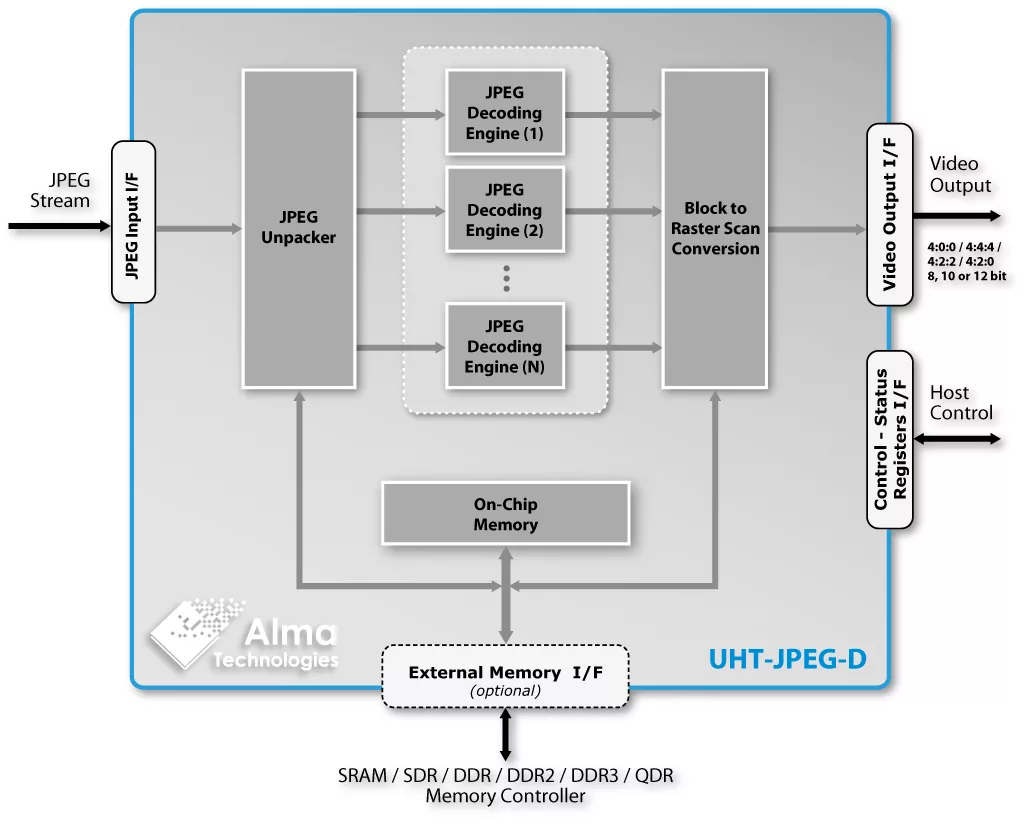
The UHT-JPEG-D accepts the standalone and standard compliant JPEG byte stream generated by the Alma Technologies UHT-JPEG-E encoder, or other compatible¹ JPEG byte stream, and outputs the decoded data in interleaved raster scan format. It supports decoding of 4:4:4, 4:2:2, 4:2:0 and 4:0:0 (grayscale) image or video streams, in 8-, 10- or 12-bit per component sample depths. The UHT-JPEG-D can be implemented using only on-chip memory resources, while using off-chip memory too is also natively supported. Designed with a user configurable architecture, the decoder scales to offer a sustained decoding throughput from 1 to 32 samples per clock cycle.
Using multiple internal processing engines, the UHT-JPEG-D offers the needed performance through its scalable parallel architecture. The input JPEG stream is split internally into chunks and each chunk is assigned to one of multiple internal decoding units. This is done in a way which is totally transparent to the system utilizing the IP, abstracting all the parallelization complexity from the rest SoC components. The number of internal decoding units is configurable before synthesis, adapting to the implementation technology speed, and non-critical resources are shared between the multiple engines.
The UHT-JPEG-D uses a single compressed data input interface and produces raster scan interleaved decoded image or video data through a single - multiple pixels - output interface. Its operation is completely standalone, without needing any host CPU or GPU power.
The UHT-JPEG-D core is designed with simple, fully controllable and FIFO-like, streaming input and output interfaces. Being carefully designed and rigorously verified, the UHT-JPEG-D is a reliable and easy-to-use and integrate IP.
Key features
- High-Performance, Compliant and Standalone Operation
- Ultra high throughput in low-end silicon using scalable and transparent parallel processing
- ITU T.81 compliance¹
- 4:4:4, 4:2:2, 4:2:0 and 4:0:0 (grayscale) image or video data decoding
- 8-, 10- and 12-bit per component sample depth
- Single JPEG byte stream input and single - multiple pixels - raster scan interleaved output
- Motion JPEG payload decoding
- CPU-less, complete and standalone operation
- Advanced Implementation
- Up to 32 samples per clock cycle decoding
- Algorithmic decoding latency of approximately 32 scan lines for 4:2:0 and 16 scan lines for all other sampling formats
- Configurable full on-chip or mixed on/off-chip memories implementation
- Flexible optional off-chip memory interface
- Independent of external memory type
- Tolerant to latencies
- Allows for shared memory access
- Can optionally operate on independent clock domain
- Avalon-ST and AXI4-Stream compliant streaming data I/O
- Trouble-Free Technology Map and Implementation
- Fully portable, self-contained RTL source code
- Strictly positive edge triggered design
- D-type only Flip-Flops
- Safe CDC transfers when using more than one clock domain
- No special timing constraints required
- No false or multi-cycle paths within the same clock domain
- No CDC transfers that need to be constrained
- (all CDC paths can be excluded)
- Limitations Applying When Using a Third-Party JPEG Encoder¹
- Single decoding engine operation may be needed
- Single scan interleaved JPEG format only
- The image dimensions declared in the SOF marker must be an integer multiple of 8
- No DNL marker
Block Diagram
What’s Included?
- Clear-text RTL sources for ASIC designs, or pre-synthesized and verified Netlist for FPGA and SoC devices
- Release Notes, Design Specification and Integration Manual documents
- Bit Accurate Model (BAM) and test vector generation binaries, including sample scripts
- Pre-compiled RTL simulation model and gate-level simulation netlist for the FPGA Netlist license
- Self-checking testbench environment sources, including sample BAM generated test cases
- Simulation and sample Synthesis (for ASICs) or Place & Route (for FPGAs) scripts
Files
Note: some files may require an NDA depending on provider policy.
Specifications
Identity
Provider
Learn more about Image Conversion IP core
Nextreme Structured ASICs: An alternative for designing cost-optimized ARM926EJ processor-based embedded systems
Video Messaging for ARM7-based Cellular Chipsets.
Configurable Processors for Video Processing SOCs
Generating High Speed CSI2 Video by an FPGA
Viewpoint: Opportunity to win on different design fronts
Frequently asked questions about image conversion IP cores
What is Scalable Ultra-High Throughput 8/10/12-bit JPEG Decoder?
Scalable Ultra-High Throughput 8/10/12-bit JPEG Decoder is a Image Conversion IP core from Alma Technologies listed on Semi IP Hub.
How should engineers evaluate this Image Conversion?
Engineers should review the overview, key features, supported foundries and nodes, maturity, deliverables, and provider information before shortlisting this Image Conversion IP.
Can this semiconductor IP be compared with similar products?
Yes. Buyers can compare this product with similar semiconductor IP cores or IP families based on category, provider, process options, and structured technical specifications.