SATCOM Adopting 3GPP Standards: From Proprietary Silos to Global Scale
SATCOM is adopting 3GPP 5G NTN standards to scale beyond proprietary silos, enabling interoperable satellite networks and global direct‑to‑cell services.
The Ceva-BX2 baseband processor IP handles both signal-processing and control workloads with up to 16 GMACs per second performanc…
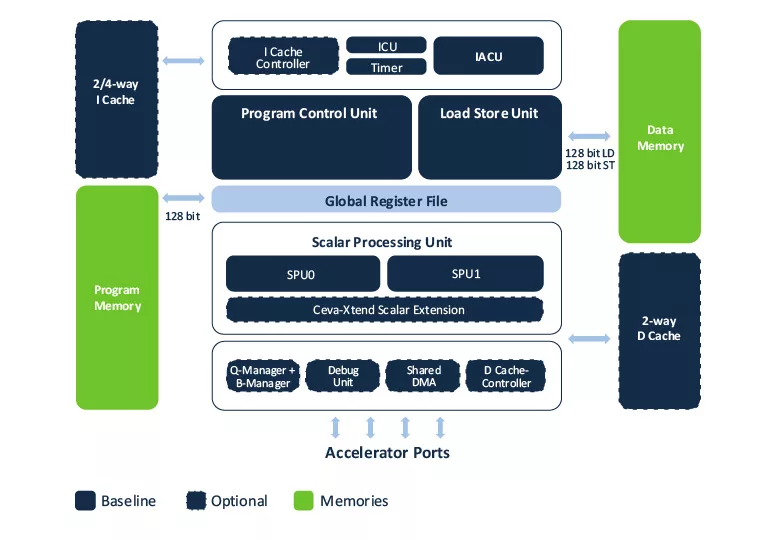
The Ceva-BX2 baseband processor IP handles both signal-processing and control workloads with up to 16 GMACs per second performance and high-level-language programming. It supports a range of integer and floating-point data types for a wide range of baseband applications like 5G PHY control, and exploits a high degree of parallelism, but with remarkably compact code size. Optimized high-speed interfaces expedite connection to other Ceva cores or to accelerators.
The Solution
The Ceva-BX2 combines the capabilities of signal processing and control-code execution into a single, compact DSP. Computational speed comes from quad-32×32/octal-16×16 MACs with added support for 16×8 and 8×8 MAC operations, organized into two parallel compute engines within an 11-stage pipeline. Each compute engine can add optional half- and single-precision IEEE floating-point units. These resources are directed by a five-way VLIW instruction set architecture with optimizations for single-instruction-multiple-data (SIMD) operation, including a hardware loop buffer for kernel execution. Efficient execution of control code is aided by dynamic branch prediction and a branch target cache. On signal-processing tasks the Ceva-BX2 can reach up to 16 GMACs per second, and on control workloads it can achieve up to 5.46 CoreMark/MHz. The hardware design is optimized for speed, achieving 2 GHz operation implemented in a TSMC 7nm process node with only common standard cells and memory compilers.
Note: some files may require an NDA depending on provider policy.

Baseband processor is a Cellular IP core from Ceva, Inc. listed on Semi IP Hub.
Engineers should review the overview, key features, supported foundries and nodes, maturity, deliverables, and provider information before shortlisting this Cellular IP.
Yes. Buyers can compare this product with similar semiconductor IP cores or IP families based on category, provider, process options, and structured technical specifications.