GZIP/ZLIB/Deflate Data Compressor
ZipAccel-C is a custom hardware implementation of a lossless data compression engine that complies with the Deflate, GZIP, and ZL…
Overview
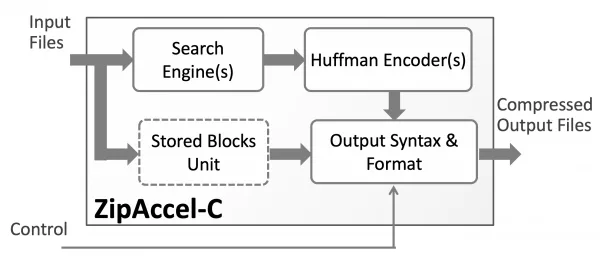
ZipAccel-C is a custom hardware implementation of a lossless data compression engine that complies with the Deflate, GZIP, and ZLIB compression standards.
The core receives uncompressed input files and produces compressed files. No post-processing of the compressed files is required, as the core encapsulates the compressed data payload with the proper headers and footers. Input files can be segmented, and segments from different files can be interleaved at the core’s input.
The core’s flexible architecture enables fine-tuning of its compression efficiency, throughput, and latency to match the requirements of the end application. Throughputs in excess of 400 Gbps are feasible even at clock rates as low as 500MHz, and latency can be as small as a few tens of clock cycles.
ZipAccel-C offers compression efficiency practically equivalent to today’s popular deflate-based software applications. Analyzing processing speed versus compression efficiency to achieve the best trade-off for a specific system is facilitated by the included software model, and by support from our team of data compression experts.
ZipAccel-C has been designed for ease of use and integration. It operates on a standalone basis, off-loading the host CPU from the demanding task of data compression, and optionally from the task of encrypting the compressed stream. Streaming AXI-Stream or native FIFO-like data interfaces ease SoC integration.
Technology mapping is straightforward, as the design is LINT-clean, scan-ready, microcode-free, and uses easily replaceable, generic memory models. Memory blocks can optionally support Error Correction Codes (ECC) to simplify achieving Enterprise-Class reliability requirements. Furthermore, input file segmentation can limit the inter-file latency and helps users achieve Quality of Service (QoS) objectives.
Key features
- Compression Standards
- Deflate (RFC-1951)
- ZLIB (RFC-1950)
- GZIP (RFC-1952)
- Deflate Features
- LZ77 with configurable block and search window size
- Static and dynamic Huffman
- Optional stored deflate blocks
- Dynamic mode selection
- Flexible Architecture
- Fine-tune Throughput, Compression Efficiency, and Latency to match application requirements
- More than 400Gbps with one core instance, scalable to meet any throughput requirement
- Compression efficiency can be on par with Unix/Linux max compression option (gzip -9)
- Silicon requirements start from less than 100k gates
- Under 40 clock cycles for Static Huffman
- Configuration options (partial list):
- Search engine and Huffman encoder architecture
- History search window size (up to 32KB)
- Deflate block size
- Stored blocks support
- Parallel processing level
- Fine-tune Throughput, Compression Efficiency, and Latency to match application requirements
- Easy to Use and Integrate
- Processor-free, standalone operation
- AXI-Stream or native FIFO-like data interfaces
- Large file segmentation enables meeting QoS objectives
- Microcode-free, scan-ready design
- Optional ECC memories
- Optionally integrated with DMA, encryption or other cores from CAST
- Complete, turn-key Accelerator Designs available on FPGA boards from different vendor
Block Diagram
Specifications
Identity
Files
Note: some files may require an NDA depending on provider policy.
Provider
Learn more about Data Compression IP core
Data compression tutorial: Part 3
Firmware Compression for Lower Energy and Faster Boot in IoT Devices
A configurable FPGA-based multi-channel high-definition Video Processing Platform
IP Core for an H.264 Decoder SoC
Digital Associative Memories Based on Hamming Distance and Scalable Multi-Chip Architecture
Frequently asked questions about Data Compression IP
What is GZIP/ZLIB/Deflate Data Compressor?
GZIP/ZLIB/Deflate Data Compressor is a Data Compression IP core from CAST listed on Semi IP Hub.
How should engineers evaluate this Data Compression?
Engineers should review the overview, key features, supported foundries and nodes, maturity, deliverables, and provider information before shortlisting this Data Compression IP.
Can this semiconductor IP be compared with similar products?
Yes. Buyers can compare this product with similar semiconductor IP cores or IP families based on category, provider, process options, and structured technical specifications.