Industry's First General-Purpose 32-bit RISC-V MCU Core Expands Design Freedom
Daryl Khoo, Renesas
SCR3 is an efficient, silicon-proven, microcontroller-class, 32/64-bit RISC-V processor core.
SCR3 is an efficient, silicon-proven, microcontroller-class, 32/64-bit RISC-V processor core. It is optimized for power-sensitive, small-area, embedded applications, that demand high performance.
SCR3 supports RISC-V standard "I" Integer, "M" Integer Multiplication and Division, "A" Atomic, "C" 16-bit Compressed, “B” Bit Manipulation, and “K” Scalar Cryptography extensions. SCR3 is equipped with an in-order 5-stage pipeline, a branch prediction unit for efficient code execution, PLIC, ACLINT, IPIC/CLIC units for efficient interrupt processing, and industry-standard AHB, AXI4, JTAG, and cJTAG interfaces for flexibility and compatibility.
The SCR3 memory subsystem includes a TCM unit, L1 and L2 caches, and an MPU unit with user and machine privilege modes that allow executing a variety of real-time operating systems. The processor core can operate in heterogenous clusters with up to 4 cores, offering hardware-level support for memory coherency and external accelerators integration.
SCR3 Key Features
| Core | |
|---|---|
| ISA | RV32/RV64(IMC[ABK]) Atomic Instructions [A], Bit Manipulation [B], Scalar Cryptography Instructions [K] — optional |
| Pipeline | 3-5 stages |
| Multicore Support (SMP) | Up to 4 cores with cache coherency |
| Branch Prediction Unit (BPU) | Static/Dynamic |
| Memory Subsystem | |
| Tightly-Coupled Memory (TCM) | Up to 256KB, error protection — ECC |
| L1 Cache | Up to 32KB + 32KB, error protection — parity/ECC |
| L2 Cache | From 128KB to 512KB, error protection — ECC |
| Memory Protection Unit (MPU) | Configurable, up to 32-region MPU |
| Interrupt Subsystem | |
| IPIC | Up to 32 interrupt lines |
| CLIC | Up to 4096 interrupt lines, up to 256 priority levels |
| PLIC | Up to 1023 interrupt lines, up to 256 priority levels |
| ACLINT | Up to 4096 interrupt lines |
| Debug Subsystem | |
| Interface | JTAG/cJTAG-compliant interface |
| Breakpoints | Up to 4 hardware breakpoints, unlimited software breakpoints support |
| Interfaces | |
| AXI | Master AXI4 AMBA standard interface |
| AHB | Master AHB AMBA standard interface |
| Timers and Counters | |
| Performance Monitoring | Up to 32 performance counters |
| Embedded 64-bit RTC Timer |
Machine- |
Development Tools
Syntacore Development Toolkit (SCR3 Optimized)
The SC-DT package is a ready-to-use software development kit containing pre-built and pre-configured tools that simplify software development for the SCR3 core. With SC-DT, you can take advantage of the pre-built tools and configurations to reduce the time and effort required to get up and running with SCR3. SC-DT supports Windows and Linux operating systems and includes:
Syntacore also supports and maintains the Zephyr operating system that is not part of the SC-DT package and is downloadable separately.
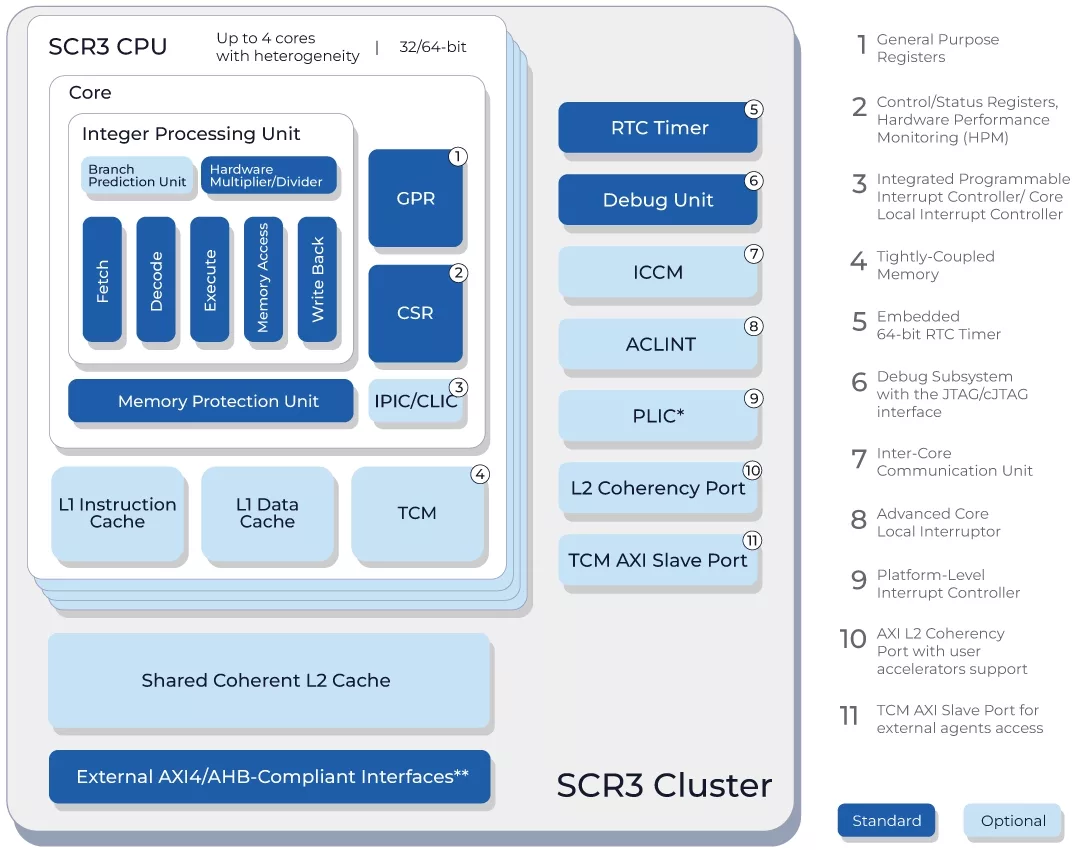
SCR3 is available out-of-the-box, configurable, written in SystemVerilog and comes with a full set of pre-built, tested, and optimized development tools, pre-configured FPGA-based SDK and complete documentation. The software package includes ready-to-use toolchains, IDEs, operating systems, bootloaders, debuggers, simulators, and sample projects that reduce the time and effort required to get up and running with SCR3.
The SCR3 product package includes:
Note: some files may require an NDA depending on provider policy.

Efficient microcontroller core with a 5-stage in-order pipeline, privilege modes, an MPU, L1 and L2 caches is a MCU IP core from Syntacore listed on Semi IP Hub.
Engineers should review the overview, key features, supported foundries and nodes, maturity, deliverables, and provider information before shortlisting this MCU IP.
Yes. Buyers can compare this product with similar semiconductor IP cores or IP families based on category, provider, process options, and structured technical specifications.