Vendor: Noesis Technologies Category: Modulation Demodulation

Configurable Soft Output Demapper

Noesis Technologies Soft Output Demapper is a structural element of any modern telecom system.

Overview

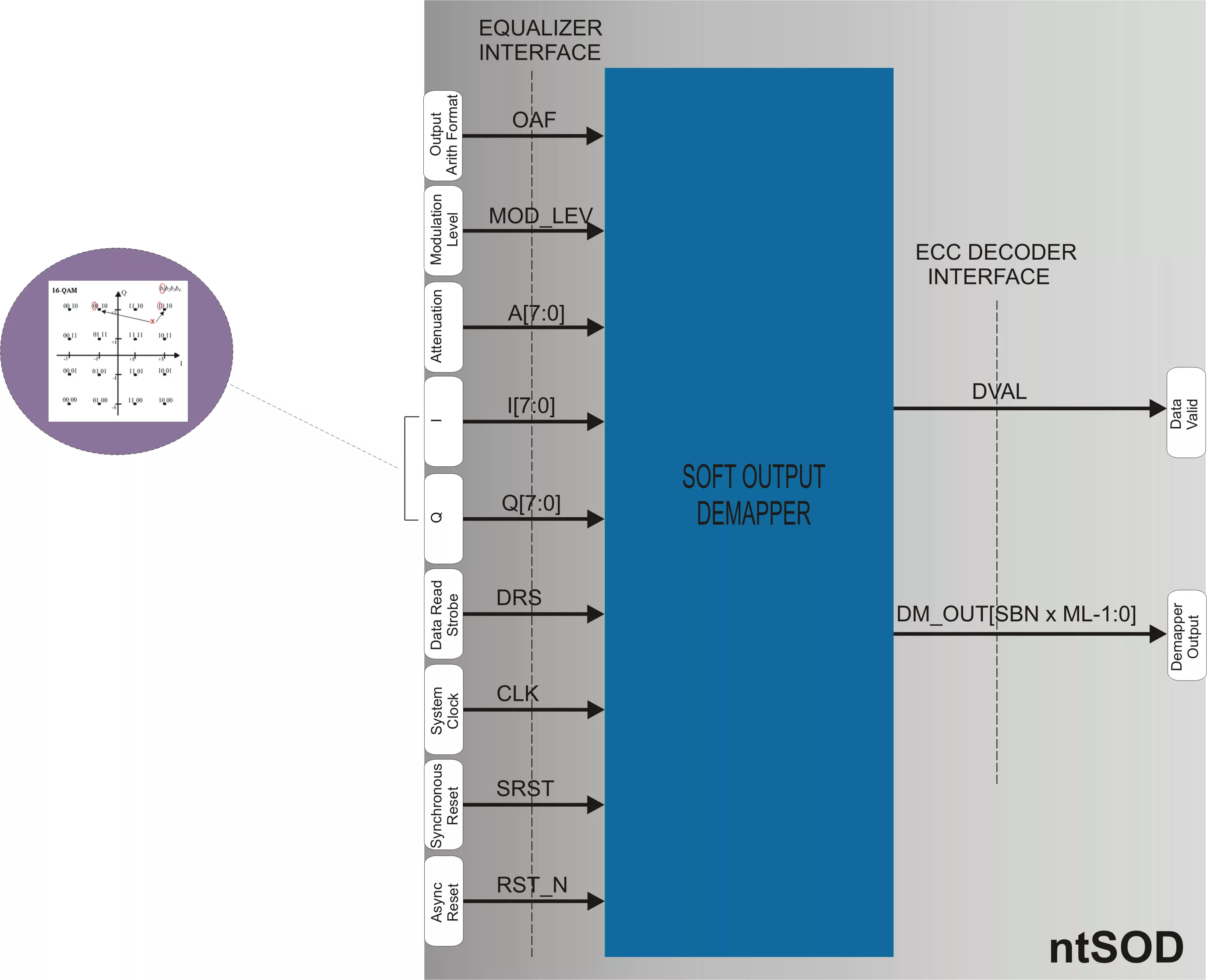
Noesis Technologies Soft Output Demapper is a structural element of any modern telecom system. The receiver extracts the phase and magnitude of the carrier signal. Subsequently a decision must be taken on the actual transmitted bits. Due to channel noisy conditions, the received signal has been distorted and there are positional errors on the constellation points. The ntSOD Soft Output Demapper IP Core implements the LLR (Log Likelihood Ratio) algorithm to convert the received distorted modulated signal from its complex I, Q form to a bit stream. It identifies the actual transmitted symbol bits and assigns to each bit a level of confidence in the format of a soft value. It sup-ports various modulation levels such as BPSK, QPSK, 16 QAM and 64 QAM. This soft-bit information can be subsequently used during ECC decoding process by a soft-input ECC decoder such as Viterbi Decoder. Soft decision ECC decoding can provide a coding gain of 2 dB for 3 soft-bits per encoded bit or 2.2 dB for 4 soft bits per encoded bit when compared with hard decision ECC decoding. The soft-bit infor-mation can be configured in sign-magnitude or 2’s complement format.

Key features

  • Soft output demapper based on the LLR (Log Likelihood Ratio)algorithm.
  • Parameterized number of soft bits per symbol .
  • Parameterized architecture depending on supported modulation levels for optimum resources utilization.
  • Programmable modulation level.
  • Supports BPSK, QPSK, 16 QAM, 64 QAM constellations.
  • Supports 2’s complement of sign-magnitude soft output arithme-tic format.
  • Compact design that requires approximately 500 Virtex-2 CLB slices.
  • Fully synchronous design, using single clock.
  • Silicon proven in Xilinx FPGA technologies for a variety of appli-cations.

Block Diagram

What’s Included?

  • Fully commented synthesizable VHDL or Verilog source code or
  • FPGA netlist.
  • VHDL or Verilog test benches and example configura-tion files.
  • Comprehensive technical documentation.
  • Technical support.

Files

Note: some files may require an NDA depending on provider policy.

Specifications

Identity

Part Number
ntSOD
Vendor
Noesis Technologies

Provider

Noesis Technologies
HQ: Greece
Noesis Technologies specializes in design,development and marketing of high quality, cost effective communication IP cores and provides expert ASIC/FPGA design services in telecom DSP area. Our solutions are key components to the most sophisticated telecom systems. Backed-up by our leading-edge expertise on forward error correction, encryption and networking technology as well as on DSP algorithm development we provide robust solutions that are used to improve data quality, increase bandwidth or reduce the overall system cost of end-application.

Learn more about Modulation Demodulation IP core

Three Major Inflection Points for Sourcing Bluetooth Intellectual Property

Synopsys is now shipping support for Bluetooth® 5.4, the latest specification from the Bluetooth SIG (Special Interest Group). The enhancements in Bluetooth 5.4 will open additional markets and use cases. This is one of the many inflection points in the Bluetooth Low Energy market that will be discussed in this paper.

Part 2: Opening the 5G Radio Interface

Carriers are now deploying 5G across the globe driven by the need to keep up with relentless mobile data growth. 5G New Radio (NR) operates at higher frequencies to increase bandwidth, but at the expense of range. There will therefore be a need for a much larger number of 5G RUs to provide the same coverage. The availability of cost-effective, reliable and open 5G radio units is therefore critical.

An Integrated, Tunable RF Filter: an Enabler for Reconfigurable Front-Ends

This paper presents the design and performance of a key RF circuit necessary for the realization of a reconfigurable, integrated RF front-end: a tunable frequency, selectable bandwidth, on-chip, “SAW replacement” filter. The on-die tunable filter presented here has a tunable center frequency up to 1 GHz, a selectable bandwidth up to 40 MHz, and an adjacent channel rejection down to 60 dB.

Design considerations for integrated CMOS receivers

To meet the demands for the multi-band, multi-mode wireless standards in the current market, a highly integrated wireless receiver (RX) is desired. CMOS technology has become the technology of choice for the integrated receiver design.

Silicon IP for Programmable Baseband Processing

An efficient IP reuse strategy relies on IP blocks with wide applicability. That makes generic blocks, such as programmable processors preferable. However, in many applications such as handheld wireless terminals, additional silicon area and power consumption compared to fixed function solutions can not be accepted.

Frequently asked questions about Modulation and Demodulation IP cores

What is Configurable Soft Output Demapper?

Configurable Soft Output Demapper is a Modulation Demodulation IP core from Noesis Technologies listed on Semi IP Hub.

How should engineers evaluate this Modulation Demodulation?

Engineers should review the overview, key features, supported foundries and nodes, maturity, deliverables, and provider information before shortlisting this Modulation Demodulation IP.

Can this semiconductor IP be compared with similar products?

Yes. Buyers can compare this product with similar semiconductor IP cores or IP families based on category, provider, process options, and structured technical specifications.

×
Semiconductor IP