Overview
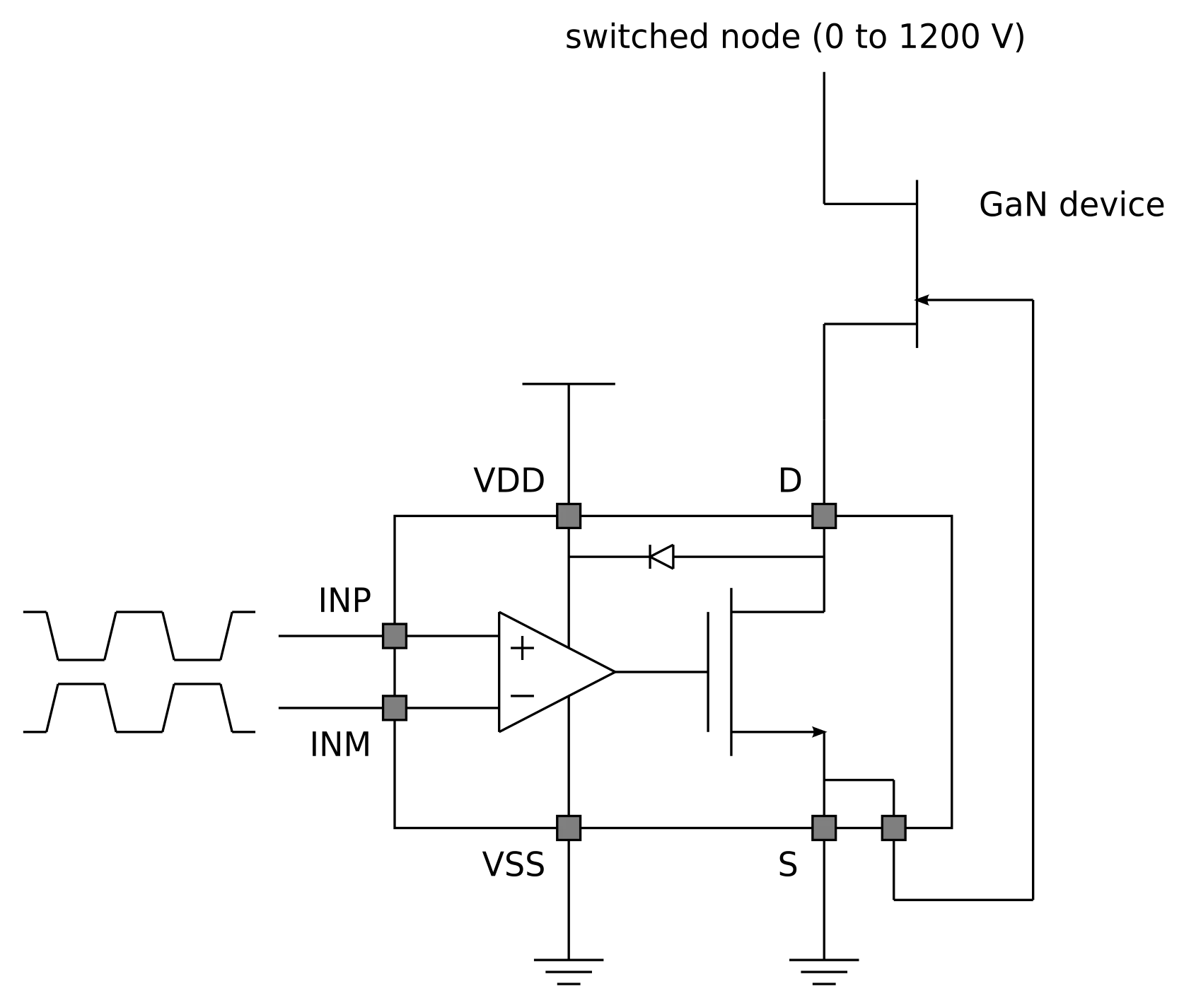
STAR2040 is a CMOS cascode driver circuit designed for use with high-current GaN (or SiC) power FET devices. It can be operated with 20 A of current, with a typical on-resistance of <15 milliohms. In a typical usage scenario, the driver can achieve a switching frequency as high as 2 MHz. This permits the use of small external passive components in switching converter applications, and hence a low BOM. The driver is implemented in a standard 5-V CMOS process, without the need for any special high-voltage devices. It requires a single 5-V power supply (VDD).
The driver state is controlled by a differential pair (INP and INM) of 5-V CMOS logic signals; this signalling scheme provides rejection of common-mode noise. Due to the on-chip pre-driver, the drive-current requirement for the INP and INM pins is small. STAR2040 incorporates a variety of monitoring and safety features, such as: (1) an integrated protection diode for the drain node; (2) an integrated analog temperature sensor; (3) a tunable rise/fall-time control circuit; and (4) monitoring capability for the drain, gate, and source nodes. Because of its high current capability, low on-resistance, and high switching frequency, STAR2040 is ideally suited for high-current, high-voltage switching converter applications that require the use of GaN (or SiC) devices. This potentially includes applications such as electric vehicles, high-current appliances, and power supplies for laptop computers.
Learn more about Power Management Unit IP core
Developing and verifying a control network in a low-power SoC is a challenging task, especially managing the different states of regulators and modes of power domains.
This article first describes state-of-the-art approaches to addressing this issue, and then delves into the solution promoted by Dolphin Integration to go further, thanks to the easy and secure Maestro� solution to manage SoC power mode transitions.
As the semiconductor industry is moving towards lower technology nodes, more and more complexity is being introduced in the design to beat the competition and provide most innovative solution to cater the needs. One of the biggest challenges that the designer faces is in terms of the keeping the power budgets of the chip within the specification and even innovate to reduce the current numbers. Depending on the application requirements, the designers have to tune up the power profile of the SoC. There are various ways to do so like dynamically changing frequency and voltage of operation, considering system level contributions to power consumption, using various modes of operation etc. In most of the cases, SoC has to support various power modes like Run mode, Sleep mode, Halt mode etc. Different power numbers are defined for each mode. Run modes can further be divided in various sub modes depending on application.
D32PRO is one of the newest 32-bit CPUs available on the market. It’s been designed by Digital Core Design, IP Core provider and SoC design house from Poland, responsible e.g. for the world’s fastest or world’s smallest 8051 CPU. DCD launched more than 70 different architectures since 1999, which have been implemented in more than 300 000 000 electronic devices, that’s why one can be sure that quite considerable experience stands behind the D32PRO.
Jim McGregor, Principal, Tirias Research
Seven Steps to Create a Formal IP Specification
Producing an Effective WLAN Prototyping Platform